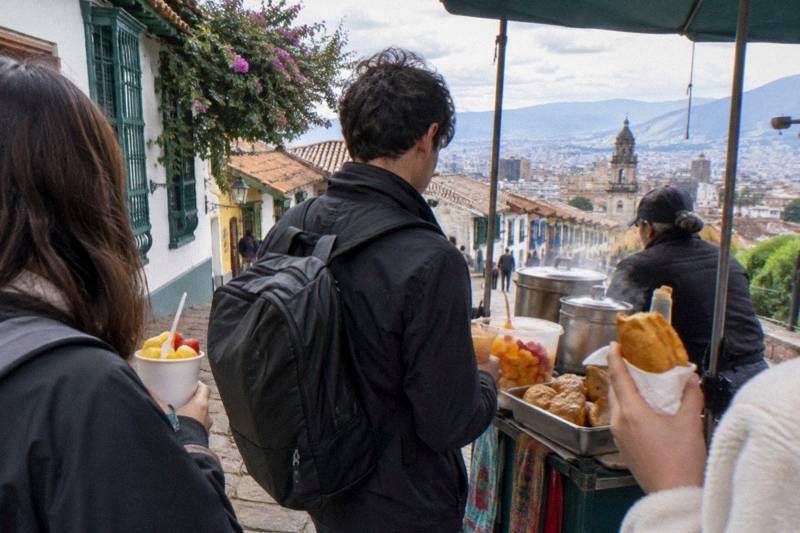
What Is A Popular Colombian Street Food?
The most popular Colombian street foods, from arepas and empanadas to obleas and fresh fruit carts, with real 2026 prices, where locals eat them in Bogotá, and how a guided walk fits in.
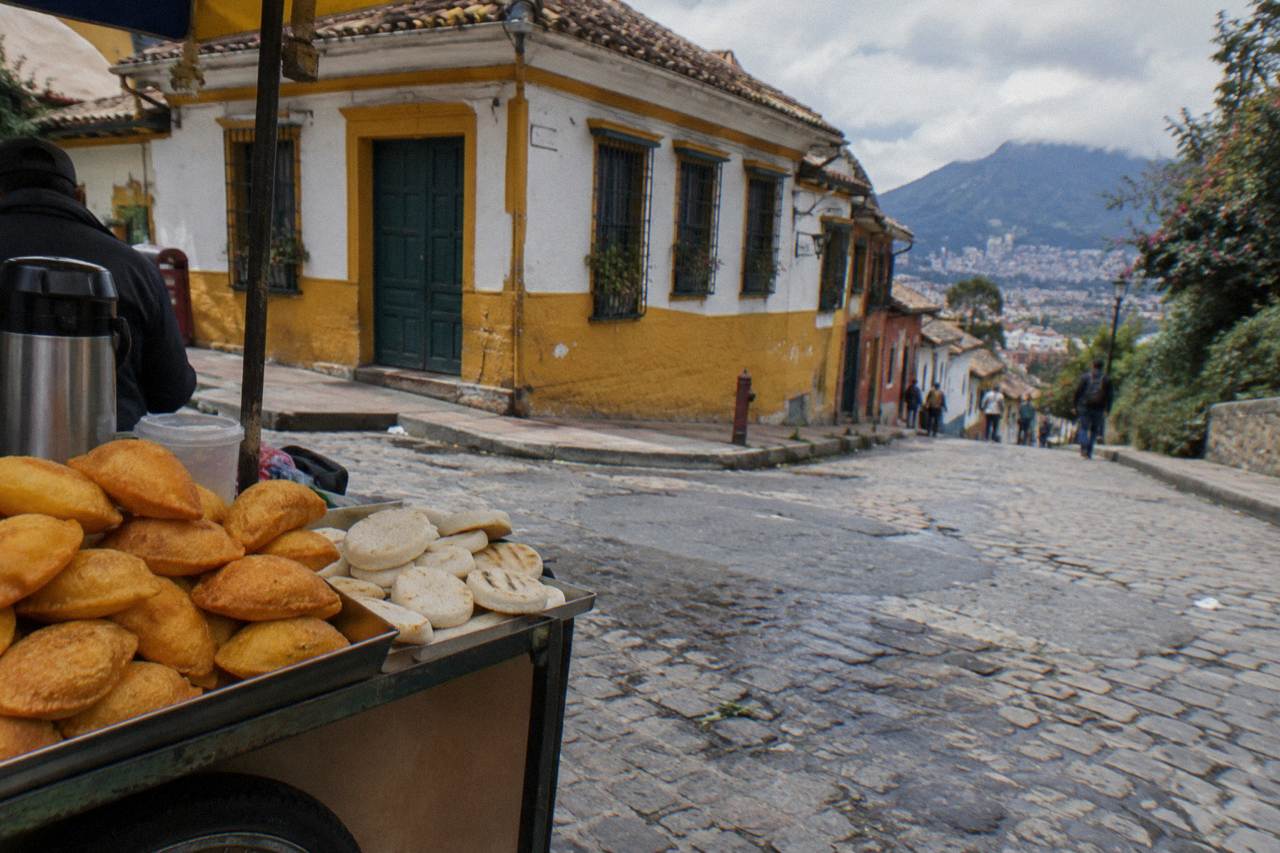
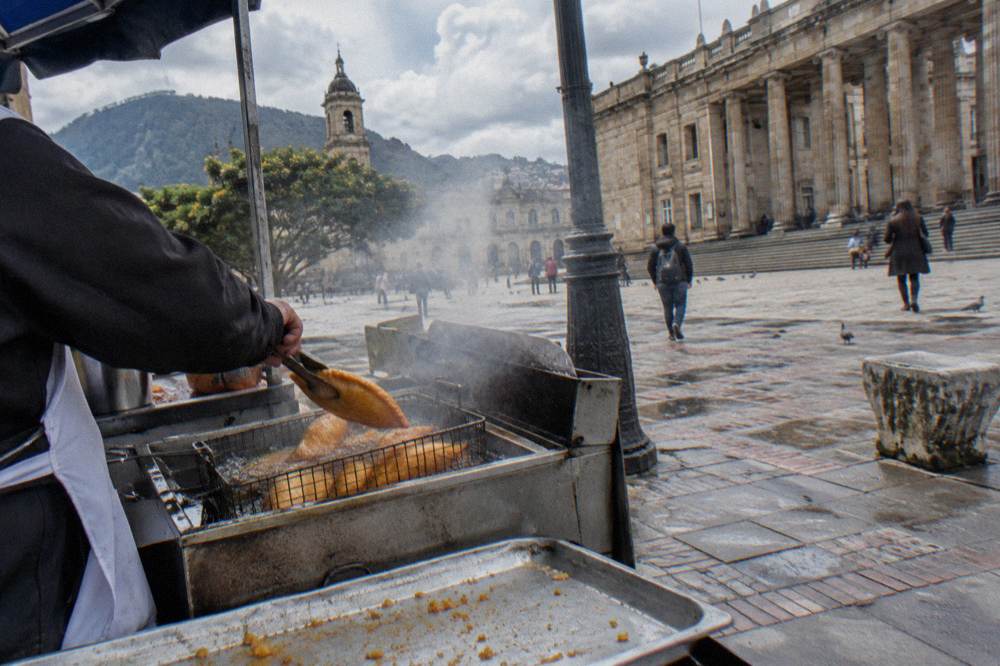
The arepa is the single most popular Colombian street food: a round griddled corn cake sold on its own, split and filled with cheese, or served beside almost any meal. Right behind it come empanadas, the fried turnover that works as the default street snack, and obleas, the arequipe-filled wafer sweet. In Bogotá you also find fruit carts pressing fresh lulo and curuba juices, tamal stands, and lechona, the stuffed roast pork of the boyacense highlands, sold by the plate.
Colombian street food is not one national dish, it is a family of corn-based, fryer-friendly, handheld things that changes shape as you move between regions. The coastal arepa de huevo is a fried pocket with an egg cracked inside. The Antioquian arepa is thin and plain. The Bogotá version leans denser, often with cheese melted into the dough. Understanding that one ingredient, corn, and its many treatments, explains most of what you will see at a stall.
Prices help too. Street food here is cheap, and the 2026 prices from Bogotá stalls and delivery menus make that concrete: an almojábana around 4,700 COP, a pan de bono around 4,300 COP, a lulo juice 4,000 COP at a La Candelaria cart. At an exchange rate near 3,183 COP to the dollar, most snacks cost a dollar or two.
That price level is exactly why a guided walk is worth considering for a first day. The Bogota Food Tours site exists for this reason: the stalls are cheap, but knowing which ones to trust, what to order and how the dishes differ takes local context. A three-hour walk spreads that context across an afternoon.
Which Street Snacks Define Bogotá?
Six snacks define the Bogotá street and market scene: the arepa, the empanada, the tamal, the almojábana and pan de bono, lechona, and obleas with arequipe. Add fresh fruit carts pressing lulo and curuba juices, and you have the full vocabulary. None of these is unique to the capital, but the highland versions, denser, warmer, built for 2,640 m altitude and cool nights, are distinct from what you find on the Caribbean coast, and knowing all six is knowing the scene.
The arepa comes first because it is everywhere. It is a flat cake of ground maize dough, griddled or fried, eaten at breakfast with butter and cheese, split as a sandwich, or served alongside soup. A good one has a charred crust and a soft interior. The empanada is the fried cousin: a half-moon of corn dough sealed around seasoned meat, potato or chicken, served with ají, a sharp cilantro-and-chili salsa, on the side. You squeeze the salsa in after the first bite.
The tamal is the weekend heavyweight. A Bogotá-style tamal mixes maize dough with chicken, pork and chickpeas, wrapped in banana leaves and steamed for hours, and it is traditionally a Sunday breakfast with hot chocolate and an arepa. Lechona is the festive one, a whole pig stuffed with rice and peas, roasted overnight, then served by the scoopful with a piece of crispy skin. The December tamal festival in Bogotá sells a combo of tamal, hot drink and arepa or bread at 10,000 COP across more than 17 plazas, and past editions moved more than 14,484 tamales, which tells you how central this dish is to the city's calendar.
Then come the bakery items and the sweet finish. Almojábanas are cheese breads with a springy, slightly sour chew; pan de bono is their denser cousin with a sharper cheese edge. Both are breakfast-and-afternoon staples, and reported delivery-menu prices put them at roughly 4,700 and 4,300 COP each. Obleas close the meal: two thin wafers glued together with arequipe, the caramel-like milk spread, sometimes with jam or grated cheese added.
| Snack | What it is | Typical form on the street | Reported price signal |
|---|---|---|---|
| Arepa | Griddled or fried maize cake | Plain with butter and cheese, or split as a sandwich | Included in tamal festival combos at 10,000 COP |
| Empanada | Fried corn-dough turnover | Meat, chicken or potato filling, ají on the side | Sold in buy-5-get-6 packs on delivery menus |
| Tamal | Maize dough with chicken, pork and chickpeas, steamed in banana leaves | Sunday breakfast with hot chocolate | 10,000 COP combo at the December festival |
| Almojábana | Springy cheese bread | Breakfast or late-afternoon snack with coffee | Around 4,700 COP each, reported |
| Pan de bono | Dense cheese-and-yuca bread | Same occasions as the almojábana | Around 4,300 COP each, reported |
| Lechona | Roast pork stuffed with rice and peas | Sold by the plate at markets and fairs | Festival and market pricing varies, check on site |
| Obleas | Arequipe-filled wafer sandwich | Street dessert | Prices vary by stall, check on site |
One practical note on how locals actually eat these: standing, quickly, and often mid-morning. Street food in Bogotá is not primarily a late-night scene the way it is in Mexico City or Buenos Aires. The rhythm is breakfast, the 4 p.m. onces snack break, and Sunday market mornings.
Wondering whether a guided version makes sense on your first visit? The question comes down to confidence and coverage.
Are Arepas And Empanadas The Same Thing?
No, and the difference is structural, not just regional. An arepa is a flat, round maize cake that is griddled or fried whole, often eaten plain or split and filled, while an empanada is a sealed, folded pastry that is always fried and always carries a savory filling inside. The arepa is the base food, eaten at every meal including breakfast; the empanada is the snack food, grabbed on the move with salsa. Confusing the two is the classic first-day mistake, and vendors will gently correct you.
The arepa is also the older and broader idea. Precolonial communities on the Caribbean coast were griddling maize cakes long before anyone folded a pastry, and every region of Colombia claims its own version. The coastal arepa de huevo fries the cake, splits it and drops in an egg, then fries it again. The Antioquian arepa is thin, sweet-edged and plain. The santandereano arepa is hard and almost cracker-like. Bogotá's versions sit in the middle: medium thickness, often with salted cheese worked into the dough.
Empanadas follow a different logic entirely. The corn dough, the filling and the fry are the whole point, and the filling is where regional identity shows up. In the highlands it is shredded chicken or beef with potato; on the coast, small seafood empanadas; in the coffee region, the empanada paisa with a soft rice-and-meat interior. All of them come with ají, and the correct move is a few drops into the bitten-open pocket, not a full pour over the top.
If you want a walk that treats this as a tasting curriculum rather than a snack, the Bogotá: True Colombian Walking Tour + Local Snacks pairs a city-centre walk with local snacks over 2 to 3 hours, from $54.68 per person, rated 4.9 across 130 reviews. A guided format means someone explains the difference between an arepa de huevo and an empanada while you are holding both.
The distinction matters when you order, too. Ask for "una arepa" and you get a plain cake, possibly with cheese on the side. Ask for "una empanada" and you will be asked which filling. Neither usually costs more than a couple of dollars, so the cheap strategy is to order one of everything and share.
Where Do Locals Eat Street Food In Bogotá?
Locals eat street food at three kinds of places: the market plazas, especially Paloquemao and La Perseverancia; the weekend scenes at Usaquén and the December tamal plazas; and the fixed carts and bakery counters of La Candelaria and the centre. Each has its own published hours and its own rhythm, and matching your visit to that rhythm matters more than matching it to any specific stall, because the same dish tastes different at 7 a.m. in a wholesale market than it does at 3 p.m. on a quiet corner.
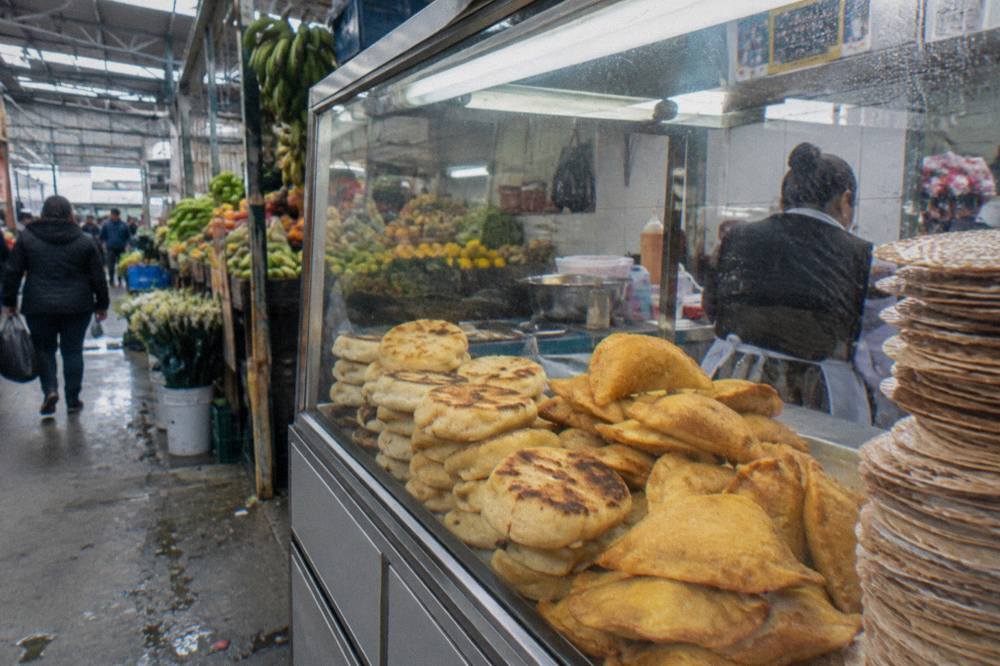
Paloquemao is the city's working wholesale-plus-retail market, open Monday to Saturday from 4:30 a.m. to 4:30 p.m. and Sundays and holidays from 5:00 a.m. to 4:30 p.m. The early hours are the real show: pre-dawn to about 10 a.m. on weekdays, trucks unload produce while vendors hand out tastes of granadilla, lulo and uchuva. The crowd thins after midday, which is when the food stalls, not the fruit, become the reason to stay. The market even hosted its first opera performance in its 54-year history in October 2026, a sign of how much the plaza's public role is being celebrated right now.
La Perseverancia, Monday to Friday 8:00 a.m. to 4:00 p.m. and weekends 6:00 a.m. to 5:00 p.m., is the traditional-cooking plaza: family-run stalls serving ajiaco, lechona, mute santandereano, mondongo and fritanga. It is smaller, grittier and closer to what home cooking in the city actually looks like. The bogota-markets-beyond-paloquemao guide covers it in detail alongside Samper Mendoza, the nocturnal herb market that runs Mondays and Thursdays from 9 p.m. to 5 a.m. with more than 500 plant species.
In La Candelaria, the stall scene is compact and cheap. One documented cart at Carrera 2a with Calle 13 sells lulo juice at 4,000 COP and curuba juice with milk at 5,000 COP, reported in August 2026. Seven such stalls around the neighbourhood are documented in local street-food coverage, mostly clustered on the Carrera 2a and Calle 13 corridor.
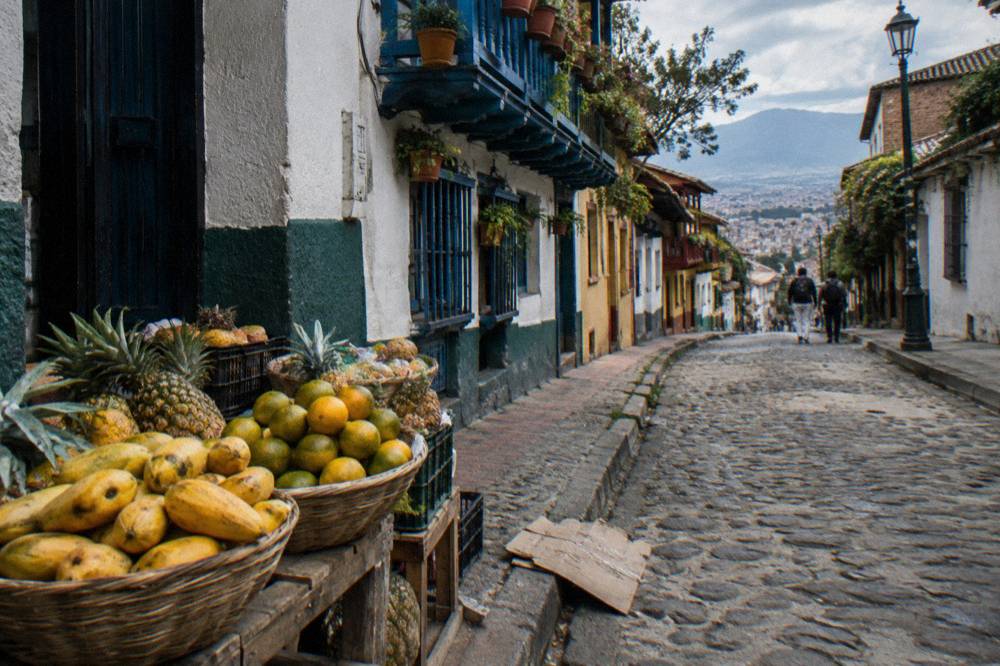
Usaquén runs the weekend version: the flea and food market at Carrera 6A between Calles 119 and 120A operates Saturdays, Sundays and holiday Mondays from 9:00 a.m. to 5:30 p.m., with stalls selling arepas, fresh-cut fruit with salt and lime, empanadas and hot chocolate. It is the most visitor-friendly of the scenes, and the one where a Sunday morning costs the least effort.
For travellers who want the stall scene decoded rather than discovered by trial and error, the Viejo Bogota Food Tour with 12+ Tastings covers the historic centre over 4 hours, from $55 per person, rated 5.0 across 714 reviews, which makes it the most reviewed food walk of the options compared here. Its tasting count is in the tour name, so the coverage is the pitch.
A note on what a guided walk adds over going alone: the tastings are counted and listed in advance, the guide handles ordering, and the market and coffee stops are fixed into the route. A solo visit is cheaper in pesos but costs you more in guesswork.
Is Colombian Street Food Safe To Eat?
Most visitors eat Colombian street food without trouble, and Bogotá's health secretariat advises buying from formal, authorized stalls. The city's health secretariat backs this up with simple advice: buy from authorized establishments, check labels and expiry dates, and avoid any food that is damaged or unlabeled. The tap water is officially potable, with the city's water risk index measured in the no-risk band, though some visitors still choose bottled water because of the chlorine taste. No one can promise conditions at any individual stall, so apply normal judgment at the counter. Hot food straight from a fryer or steamer is the safest category of all.
The health secretariat's own advisories, including its end-of-year and Halloween guidance, repeat the same core recommendations: prefer formal and authorized sellers, look at the condition of packaging, and skip anything unlabeled or damaged. That advice is aimed at packaged snacks and sweets as much as at hot food, and it is worth reading the official guidance directly before a trip.
Hot food is the safer category by its nature. An empanada fresh from the fryer, a tamal straight from the steamer, and lechona kept hot in its serving pan have all passed through temperatures that deal with most concerns. The categories to be more careful with are anything containing mayonnaise or dairy sitting at room temperature, pre-cut fruit from an uncertain source, and drinks with ice on very hot days. Fresh-pressed juices at a busy cart, made in front of you from whole fruit, are a different case from juice that was pressed hours earlier. More of these guides are collected on Bogota Food Tours.
The water question deserves its own sentence because it shapes everything else. Bogotá's tap water meets official standards, and it is the one Colombian city where foreign travel advice explicitly considers it safe. The city's water utility publishes its risk index, which has sat in the no-risk range, and a November 2025 sample came in at 2.09 percent on a scale where 0 to 5 percent means no risk. Some visitors still prefer bottled for taste reasons, which is a reasonable personal choice, not a safety verdict.
For safety context beyond food: the US State Department advisory for Colombia is Level 3, Reconsider Travel, issued 31 March 2026, with some departments at Level 4; none of the Level 4 areas is Bogotá. The practical consequences for a food-focused visitor are ordinary ones: keep your phone secure in crowds, use app-based or hotel-arranged transport at night, and in La Candelaria stick to main streets after dark. The is-bogota-street-food-safe-and-can-you-drink-the-tap-water guide covers this in full.
How Much Does Street Food Cost In Bogotá?
Reported 2026 prices put individual street snacks between 4,000 and 5,000 COP at stalls and carts, roughly 1.25 to 1.60 US dollars each, with the December tamal festival combo at 10,000 COP and market-restaurant portions sitting higher, at 23,700 to 33,900 COP for a 16 to 24 oz ajiaco on delivery menus. Nothing on the street list needs a budget plan. Each stop costs a dollar or two, and even the festival combos land near three dollars, so the real constraint is stomach space, not wallet.
The verified figures, all reported from 2026 sources, are these:
| Item | Reported price (COP) | Approx. USD at 3,183 COP | Source type |
|---|---|---|---|
| Lulo juice, La Candelaria cart | 4,000 | ~1.25 | Street cart, August 2026 |
| Curuba juice with milk, same cart | 5,000 | ~1.57 | Street cart, August 2026 |
| Almojábana, per unit | ~4,700 | ~1.48 | Delivery menu |
| Pan de bono, per unit | ~4,300 | ~1.35 | Delivery menu |
| Tamal festival combo (tamal + hot drink + arepa or bread) | 10,000 | ~3.14 | City festival pricing |
| Ajiaco, mediano 16 oz, delivery example | 23,700 | ~7.44 | Delivery menu |
| Ajiaco, grande 24 oz, delivery example | 33,900 | ~10.65 | Delivery menu |
| VegUp! festival bowl | 21,000 | ~6.60 | Festival fixed price |
Two caveats keep that table honest. First, delivery-app prices for things like ajiaco are restaurant prices, not street prices, and a market-plaza ajiaco will usually cost less. Second, exchange rates move; the figure of about 3,183 COP per dollar was the rate in early November 2026, and the peso moved within a range of roughly 0.0003 to 0.000319 USD through the preceding month. Treat the dollar column as a rough guide, not a promise.
Against that backdrop, guided food walks are priced for convenience, not for the raw food cost. The three street-food walks featured here range from $17.71 per person for the Shared Bogotá Street Food Tour, 3 hours, rated 4.6 across 30 reviews, to $55 for the Viejo Bogota walk with its 12+ tastings, with the True Colombian Walking Tour + Local Snacks at $54.68. What you are buying is a route, an interpreter and a set of stops chosen in advance, since the food itself on any of these budgets is the cheap part.
Tipping sits on top of all this and is light. At sit-down restaurants staff ask whether to add the voluntary 10 percent propina, which is optional by law and can be declined. At street stalls and counters, tipping is not expected at all; rounding up a delivery or taxi fare is the usual gesture, at around 2,000 to 10,000 COP.
Can You Cover Colombian Street Food In One Day?
Yes, comfortably. A realistic single day pairs a morning market plaza, Paloquemao for fruit and snacks before midday, with an afternoon walking tour through La Candelaria's stalls, and finishes with a sit-down ajiaco or lechona plate at a market restaurant. Budget four to six hours of eating, pace the portions, and use the altitude as your excuse to walk between stops.
The altitude point is a real one, not a footnote. Bogotá sits at about 2,640 m, and the standard advice is 1 to 2 days of adaptation before anything strenuous, heavy hydration, light meals and little alcohol in the first 48 hours. Heavy fried food and a beer at altitude hit harder than at sea level, so a street-food day is better scheduled as several small stops than one giant plate. The eating-at-altitude-in-bogota-what-first-timers-should-know guide unpacks the full picture.
A sample day that uses the verified hours: start at Paloquemao between 7 and 10 a.m. for the wholesale energy and fruit tasting, take TransMilenio or a short taxi to the centre, graze the Carrera 2a and Calle 13 carts in La Candelaria for a juice and an empanada, and either book a guided afternoon walk or finish at La Perseverancia before its 5 p.m. weekend close. On a Sunday, swap the morning for Usaquén's 9 a.m. to 5:30 p.m. market and its arepas, cut fruit and hot chocolate.
Guided or self-guided is the one genuine fork in the plan. Self-guided costs less in pesos and gives you full control of pace. If it is your first day in the country and your Spanish is thin, the guided version earns its price on the first stop.
One last planning note that is easy to miss: December is the best month to do this. The tamal festival runs 5 to 8 December, the Festival del Tamal specifically, and the city's plazas fill with the combos and crowds that make street food feel like the event it is. For a deeper dive into the full dish list, the bogota-street-food-guide is the companion page.
Common Questions About Colombian Street Food
What Is A Popular Colombian Street Food?
The arepa, a round griddled maize cake, is the most popular Colombian street food, followed closely by the empanada, a fried filled turnover. In Bogotá, obleas with arequipe, tamal, lechona and fresh fruit juices round out the standard stall list.
What Is The Difference Between An Arepa And An Empanada?
An arepa is a flat maize cake cooked whole on a griddle or in a fryer, while an empanada is a folded, sealed pastry that is fried with a savory filling inside. Arepas are eaten at any meal; empanadas are snacks eaten on the move with ají salsa.
How Much Does Street Food Cost In Bogotá?
Reported 2026 prices put juices at 4,000 to 5,000 COP, almojábanas and pan de bono at roughly 4,300 to 4,700 COP, and the December tamal festival combo at 10,000 COP. Individual stops cost a dollar or two each, so a grazing session is limited by appetite rather than budget; check the stall for current prices.
Is Street Food In Bogotá Safe For Tourists?
Busy, formal stalls are generally considered safe, and the city's health secretariat advises buying from authorized sellers and avoiding unlabeled or damaged items. Bogotá's tap water is officially potable, though some visitors choose bottled. No individual stall can be guaranteed, so use normal judgment and prefer food cooked hot in front of you.
Where Is The Best Place To Try Street Food In Bogotá?
Paloquemao market in the morning for fruit and snacks, La Candelaria's cart corridor around Carrera 2a and Calle 13, La Perseverancia for traditional cooked dishes, and the Usaquén weekend market for an easy Sunday version. No venue ranking is verified, so treat these as scene descriptions rather than a leaderboard.
Do Colombians Eat Street Food For Breakfast?
Yes, and breakfast is one of the strongest street-food moments. Tamal with hot chocolate is the classic Sunday breakfast, and almojábanas, pan de bono and calentado all appear at morning counters alongside coffee.