Bogotá Street Food: What To Try, What To Skip And How To Order
Bogotá's street food runs from griddled arepas at dawn to obleas smeared with arequipe in the afternoon. Here is what the carts actually sell, what the reported prices look like, and how to eat from them with confidence.
Short answer
Bogotá's street food centres on arepas, empanadas, pan de bono, fruit cups and obleas, with reported prices from about 4,000 to 5,000 COP for single items and tamal combos around 10,000 COP at festival stalls. A guided walk such as the Shared Bogotá Street Food Tour runs from $17.71 per person and takes you stall to stall with a local.
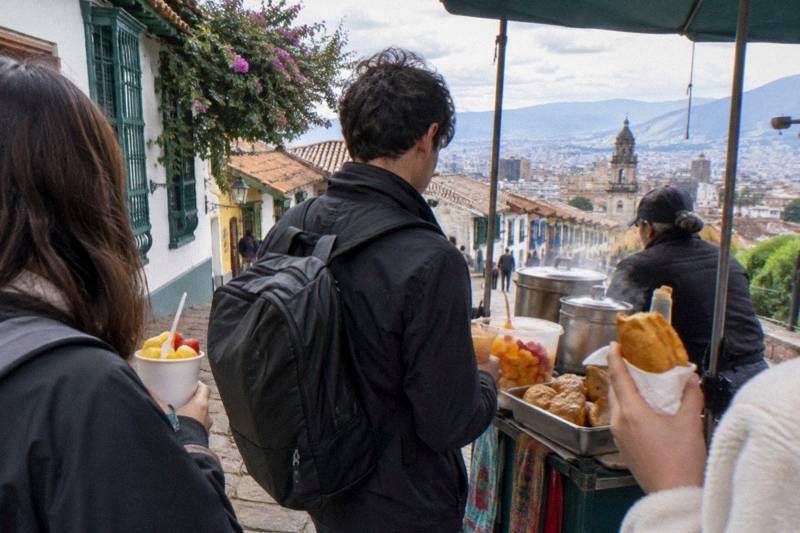
Bogotá eats standing up more than most visitors expect. Before nine in the morning the bakery windows sell almojábanas and pan de bono to commuters, by midday the market plazas ladle ajiaco and mute, and in the late afternoon the obleas carts appear near the squares with their tins of arequipe and jam. None of this is hidden or difficult: it is the cheapest and most direct way into the city's food culture, and most of it costs less than a coffee back home.
What trips people up is not the food itself but the unfamiliarity. Which cart? What is that pastry? Is the juice safe? This guide walks through the dishes worth queuing for, the reported prices from 2025 and 2026 sources, the habits that keep street eating uneventful, and the situations where a guided walk earns its fee. The costs below come from reported market and delivery listings, so treat them as ballparks and check the price at the stall before you order.
What Counts As Street Food In Bogotá?
Street food in Bogotá is less about carts on random corners and more about fixed locations: bakery counters, market plaza stalls, fruit stands outside transport hubs, and the weekend flea market in Usaquén. The city does not have a single hawker district the way some Asian capitals do. Instead, each format has its own place and hour, and knowing which is which is most of the skill.
Bakeries carry the morning. Almojábanas, the cheese-flour rolls that go with hot chocolate, run about 4,700 COP per unit at city bakery chains, and pan de bono, the yucca-cheese bread, about 4,300 COP, both from current delivery menu listings. Fruit stands cluster where people pass: outside universities, at market entrances, and along the main drags of La Candelaria, where one cart at Carrera 2a with Calle 13 sold lulo juice for 4,000 COP and curuba juice with milk for 5,000 COP as reported in August 2026.
Then there are the plazas. Paloquemao opens at 4:30 a.m. on weekdays and runs to 4:30 p.m., Sundays and holidays from 5:00 a.m. to 4:30 p.m., and its juice and fruit stalls are the cheapest full breakfast in the city. Usaquén's flea market operates Saturdays, Sundays and holiday Mondays from 9:00 a.m. to 5:30 p.m. on Carrera 6A between Calles 119 and 120A, with stalls selling arepas, fresh-cut fruit with salt and lime, empanadas and hot chocolate. These are the three street-food geographies worth planning around, and each gets its own section below.
What To Try: The Dishes Worth Ordering
Order arepas, empanadas and pan de bono first, then a fruit cup with fruits you cannot name, then obleas for dessert. Each of these is general, everywhere street food, not a hidden specialty: the arepa is the corn base, the empanada the fried hand-held, the oblea the sweet finish. Reported single-item prices run roughly 4,000 to 5,000 COP, so a full snack crawl stays under a few dollars.
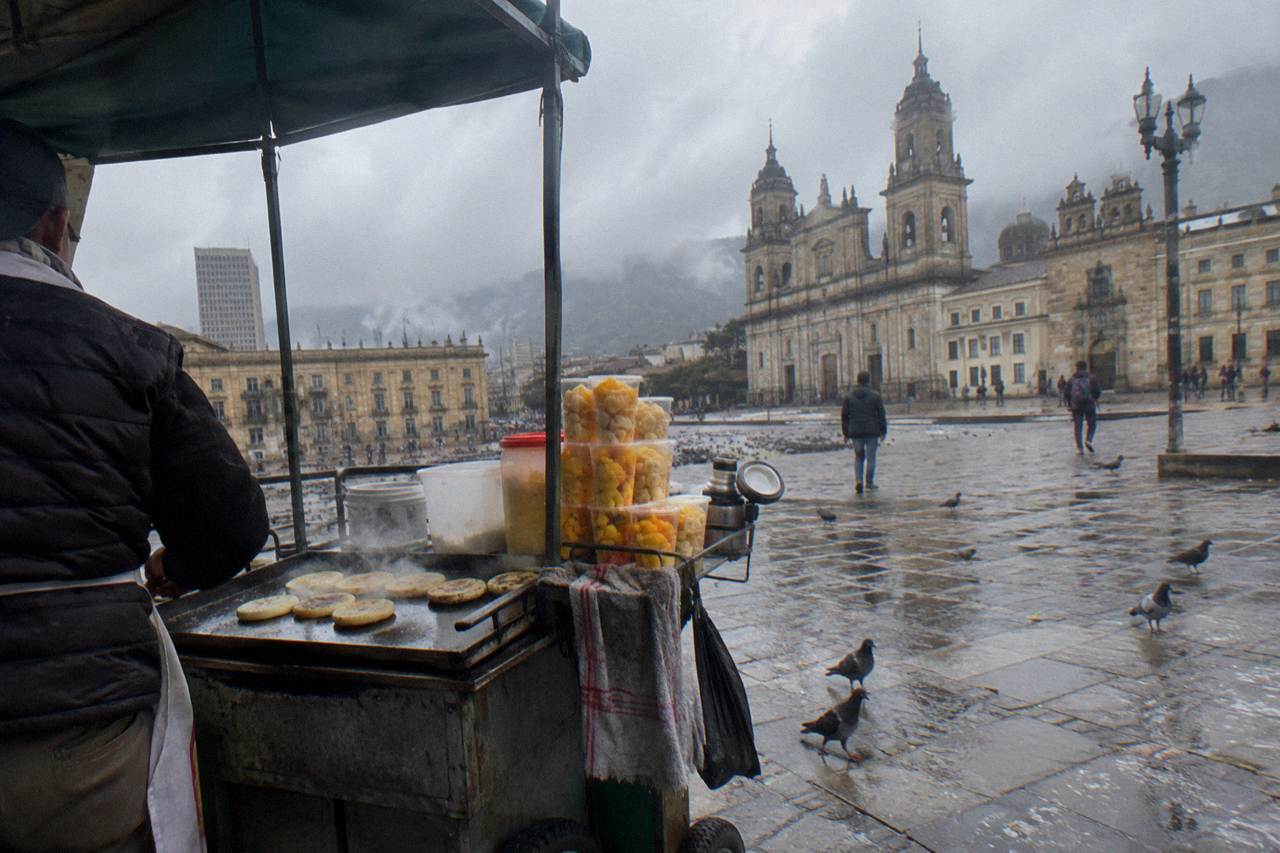
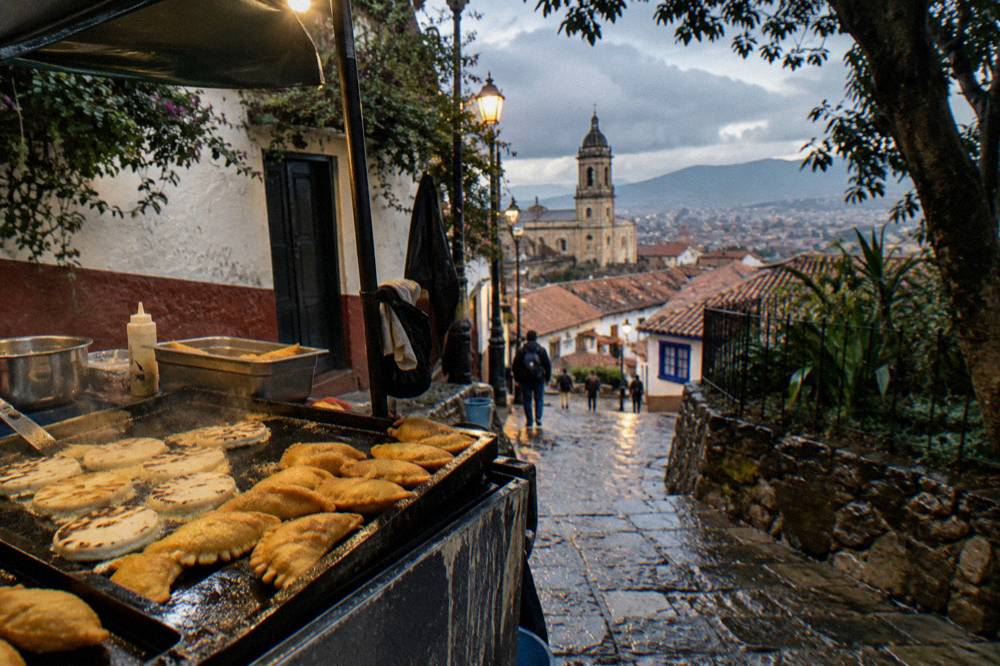
The arepa deserves patience. In Bogotá it is usually griddled flat and served with cheese or butter rather than stuffed and fried the way coastal arepas are, and the difference matters when you order. Empanadas, fried pastries filled with meat or potato, are the universal quick bite, sold by the unit and often in buy-five-get-six packs at bakeries. Pan de bono and almojábana are the bakery pair, best within an hour of the oven and both tied to the hot chocolate tradition covered in our guide to chocolate santafereño with cheese.
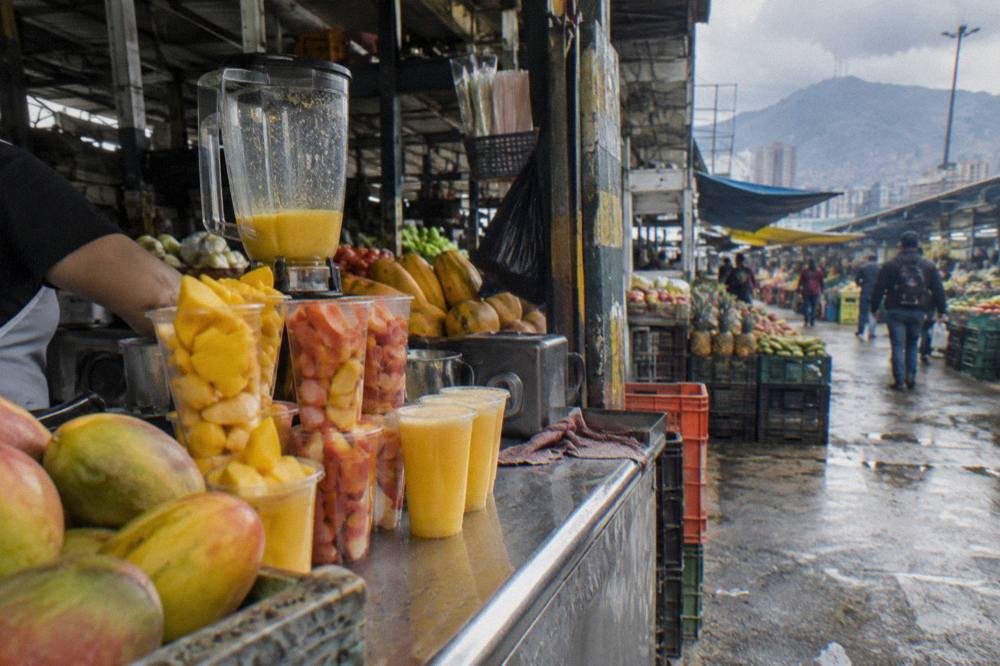
Fruit is where Bogotá outclasses most capitals. Lulo, curuba, granadilla, uchuva and maracuyá appear as juices and in cups at prices a fraction of what the same fruits cost abroad, and Paloquemao's stalls will often cut one open so you can taste before you buy. If you want a deeper dive into the fruits themselves, our guide to the Colombian fruits to try in Bogotá lists them by season. For dessert, the oblea is two thin wafers with arequipe and optionally cheese or jam, assembled at the cart while you wait.
| Item | What It Is | Reported Price | Where To Get It |
|---|---|---|---|
| Almojábana | Cheese-flour roll, eaten with hot chocolate | About 4,700 COP each | Bakeries, morning |
| Pan de bono | Yucca and cheese bread | About 4,300 COP each | Bakeries, morning |
| Lulo juice | Fresh tropical fruit juice | 4,000 COP | Fruit carts, La Candelaria |
| Curuba juice with milk | Banana-passionfruit blended with milk | 5,000 COP | Fruit carts, La Candelaria |
| Tamal combo | Tamal plus hot drink plus arepa or bread | 10,000 COP | Festival stalls at market plazas |
| Oblea | Wafer sandwich with arequipe | Varies, check the cart | Squares and parks, afternoon |
Skip nothing on safety grounds alone, but do skip anything that has sat uncovered or unrefrigerated for hours, and skip raw preparations from stalls with no running water. The judgment calls are covered in the safety section below.
If you would rather have the stalls chosen for you, three walks cover this exact territory in different formats, from a budget shared walk to the most reviewed food walk in the city.
How Much Does Street Food In Bogotá Cost?
A DIY street snack crawl in Bogotá costs very little by international standards: reported single items run about 4,000 to 5,000 COP, a tamal combo at festival stalls was 10,000 COP, and a pint of craft beer at a brewpub runs about 80,000 COP if you slide from snacks into drinking. A guided street food walk starts at $17.71 per person and bundles the stops into one price.
The exchange rate context helps. As of early November 2026, one US dollar bought roughly 3,183 COP, so a 4,700 COP almojábana is about $1.50, and a 10,000 COP tamal combo about $3. Those are reported prices from market stalls and delivery listings, not fixed tariffs: plaza stalls set their own prices, festival pricing shifts year to year, and the December tamal festival's 10,000 COP combo comes from the 2025 edition's 17 participating plazas, with prior editions selling more than 14,484 tamales.

What the guided options cost, side by side, from the current prices on each operator's page:
| Walk | Duration | Price Basis | Rating |
|---|---|---|---|
| Shared Bogotá Street Food Tour | 3 hours | From $17.71 per person | 4.6 across 30 reviews |
| Viejo Bogota Food Tour with 12+ Tastings | 4 hours | From $55 per person | 5.0 across 714 reviews |
| Bogota Shared Gastronomy Tour, Historic Center | 3 hours | From $15, guide fee only, tastings about US$12 extra | 4.9 across 291 reviews |
Read the third line carefully, because it is the classic pricing trap in this category. The Shared Gastronomy Tour's headline figure is a guide fee, and the tastings cost roughly US$12 more per person on top, which changes the comparison completely. The listing's inclusions page states what is and is not covered, and the same check applies to any walk you book: confirm what the price includes before assuming tastings are in it. For a fuller cost breakdown across every format, see what a Bogotá food walk costs.
If the stall-picking is what worries you rather than the budget, the cheapest guided entry point is the one above.
Is Street Food In Bogotá Safe To Eat?
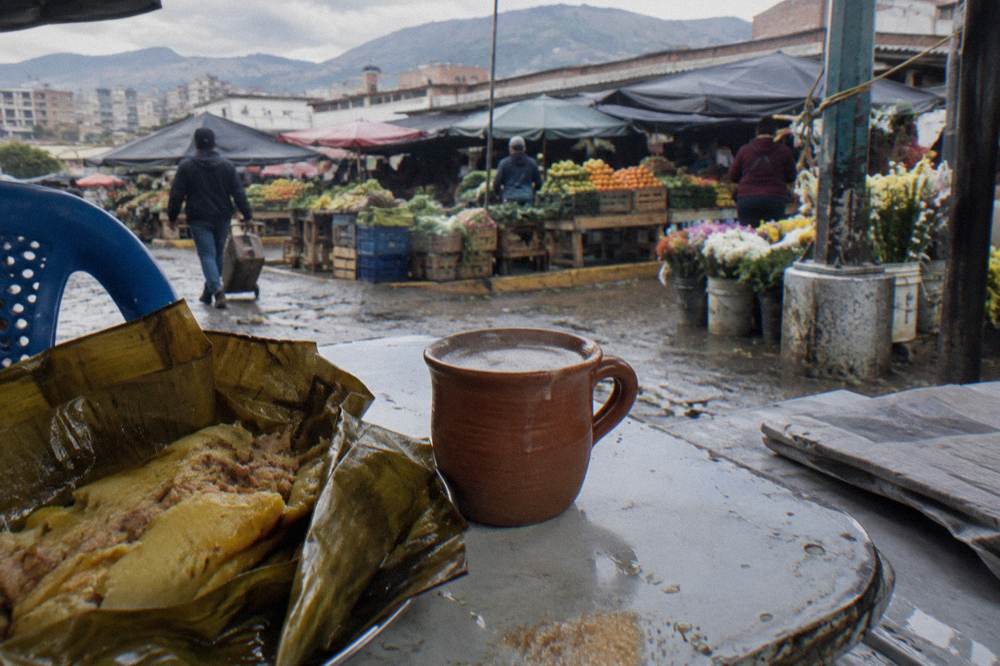
Bogotá's street food is broadly safe to eat if you apply ordinary stall-picking habits, and the city's health secretariat publishes exactly those habits: buy from formal or authorised establishments, check labels and expiry dates, and avoid damaged or unlabeled items. The tap water is officially potable, though some visitors still choose bottled. No food is risk-free anywhere, but with sense, stalls are an uneventful part of eating here.
The official guidance is specific and worth quoting loosely. Bogotá's health secretariat advisories, repeated in its end-of-year and Halloween 2026 guidance, tell residents buying from street vendors to prefer formal, authorised establishments, to check packaging condition, and to avoid unlabeled products. That is the same advice applied to the juice cart as to the tamal stall: prefer stalls with fixed premises or permits, watch whether the vendor handles money and food with separate hands, and favour items cooked in front of you over items that have waited.
Two Bogotá-specific notes. First, the tap water: official sampling puts the city's water in the no-risk band, and UK travel advice singles Bogotá out as the one Colombian city where tap water is considered safe, though some travelers still prefer bottled for taste. That means juice made with water or milk from a busy stall is a reasonable bet, but a slow stall where milk has sat is not. Second, altitude: Bogotá sits at about 2,640 m, and official advice suggests light meals and easy pacing in your first day or two, which argues for grazing rather than one heroic fritanga plate on arrival. Our page on eating at altitude in Bogotá covers this in full.
What is not on the official list: any blanket assurance. Conditions at stalls vary, vendors change, and no advisory promises every cart. If you want the safety question handled for you, a guided walk puts the stall selection in a local's hands, and the general safety picture for tourists, including the current Level 3 US advisory issued 31 March 2026, is covered separately in is Bogotá safe for tourists.
How To Order Without Spanish Fluency
Pointing works at almost every stall, but five words change the experience: "una de eso, por favor" gets you one of anything, "cuánto cuesta" gets the price, "sin" plus an ingredient gets it removed, "para llevar" gets it wrapped, and "propina" is the tip word you will rarely need at a counter. Colombian Spanish is clear and stall vendors are used to visitors, so a smile and partial Spanish carry you far.
Prices are usually posted or spoken; confirm with "cuánto cuesta" before the item is in your hand, since festival and market pricing is set per stall. Paying with small notes helps: a 2,000 or 5,000 COP note for a juice is routine, while handing over a large note for a 4,000 COP arepa will sometimes mean a wait while change is found. Contactless payment is common in sit-down places but not at carts, so carry cash in small denominations for street eating. The wider set of guides lives on Bogota Food Tours.
Tipping is simpler than in the restaurants. The voluntary 10 percent propina applies at sit-down tables, capped by law, and is not expected at counters or street stalls; our guide to tipping in Bogotá covers where it applies. At a cart, nothing is expected, and at a market lunch stall, rounding up is a normal, optional gesture.
Dietary needs need a sentence of care. Nothing in general street food knowledge is guaranteed vegan or gluten-free: arepas are corn-based but often carry cheese or butter, empanadas are wheat-battered and fried in shared oil, and juices may be blended with milk. If a dietary restriction is strict, ask directly at the stall, and if booking a guided walk, message the operator before booking rather than assuming. Roughly 36 percent of the city's restaurants offer vegan or vegetarian options per city reporting, but that figure does not extend to carts.
Where To Find The Best Street Stalls
Go where the formats live: Paloquemao for fruit and market eating before midday, La Candelaria for juice carts and bakery counters between sights, Usaquén on weekends for the flea market's food stalls, and La Perseverancia for traditional plaza cooking including ajiaco, lechona and fritanga. Each has fixed hours and a distinct character, so the best stall is really the best neighborhood at the right hour.
Paloquemao is the powerhouse. Weekdays from 4:30 a.m., wholesale trucks unload and vendors offer tastes of granadilla, lulo and uchuva, and the energy thins after midday, so go before 10 a.m. if you want the market at full volume. Usaquén's Sunday market, 9:00 a.m. to 5:30 p.m., is the gentlest introduction: arepas, fresh-cut fruit with salt and lime, empanadas and hot chocolate among the handicraft stalls. La Perseverancia, open weekdays 8:00 a.m. to 4:00 p.m. and weekends from 6:00 a.m., is where family-run stalls cook ajiaco, lechona, mute santandereano and fritanga, and it anchors the traditional side of the city's 2026 market tourism route.
| Location | Hours (Reported) | What The Stalls Sell |
|---|---|---|
| Paloquemao | Mon-Sat 4:30 a.m.-4:30 p.m.; Sun and holidays 5:00 a.m.-4:30 p.m. | Exotic fruit, juices, market cooking |
| Usaquén flea market | Sat, Sun and holiday Mondays 9:00 a.m.-5:30 p.m. | Arepas, fresh-cut fruit, empanadas, hot chocolate |
| La Perseverancia | Mon-Fri 8:00 a.m.-4:00 p.m.; weekends from 6:00 a.m. | Ajiaco, lechona, mute, mondongo, fritanga |
| Samper Mendoza | Nocturnal market Mon and Thu 9:00 p.m.-5:00 a.m. | Herbs, aromatics, plants (over 500 species) |
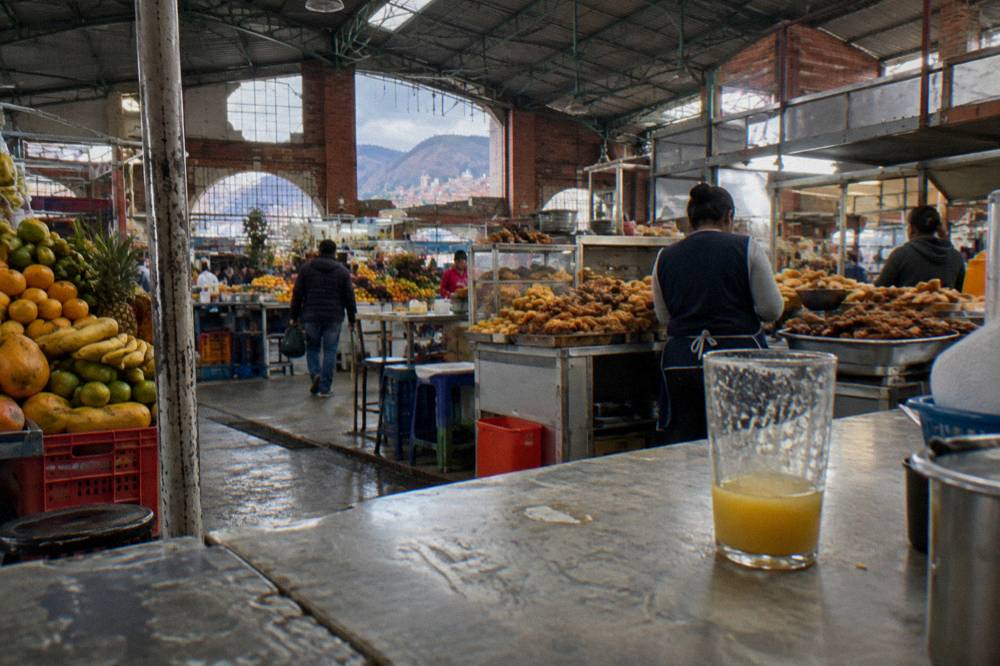
If markets are your reason for visiting, a fruit-focused walk turns the produce aisles into a tasting menu. The shared exotic fruit tour at Paloquemao runs 3 hours from $50.17 per person, rated 4.6 across 32 reviews, and the private version with 25+ tastings runs from $103 per person, rated 5.0 across 19 reviews, per the operators' pages.
For the neighborhood picture beyond markets, Chapinero Alto was named the 7th coolest neighborhood in the world by Time Out in September 2026, the only Latin American entry in its top ten, and its dining scene is part of why. Our guide to Bogotá food by neighborhood maps where to eat what across the city.
Guided Walk Or Go Alone?
Go alone if you are confident picking stalls and happy reading a market; book a walk if you are short on time, uneasy about safety, or want dishes explained and counted. Guided walks in this city start from $17.71 per person for a shared format, and the food walks compared here run up to $63 with tastings included, so the decision is less about money than about how much hand-holding you want at the counter.
The honest case for a guide is translation plus curation. A guide orders for you, explains what guascas does to an ajiaco, tells you which fruit is ripe, and moves you past the stalls that look good and are not. The honest case against is that Bogotá's street food is not hard to access alone: prices are low, stalls are fixed, and the dishes are simple. Many travelers split the difference, taking one walk early in the trip to learn the landscape, then eating independently after.
The two strongest guided options, at opposite ends of the format range, both run through La Candelaria and the historic center. The Viejo Bogota Food Tour with 12+ Tastings is the most reviewed food walk among the tours described here, rated 5.0 across 714 reviews, from $55 per person for 4 hours, and its listing counts out more than a dozen tastings, the deepest sampling of any walk in this category.
For a shorter, cheaper format, the Food Tour in La Candelaria runs 3 hours from $63 per person, rated 4.9 across 72 reviews, with the price varying by group size per the operator's page.
If you are weighing formats in detail, our comparison of which Bogotá food walk to book and the case for a private food tour in Bogotá both break down the trade-offs. For more on what street snacks mean in the national picture, see also our piece on a popular Colombian street food.
A Sample Street Food Day In Bogotá
Start at a bakery for almojábana and hot chocolate around 8 a.m., move to Paloquemao before 11 a.m. for fruit tastings and a juice, take a tamal or empanada at a plaza stall at lunch, snack on an oblea near a square in the afternoon, and end with a craft beer if the day runs long. Every item on that route has a reported price above, and none of the street items exceeds about 10,000 COP.
The morning bakery stop is the cheapest and easiest. An almojábana at about 4,700 COP with a hot chocolate is the city's own breakfast, not a tourist invention, and the pairing is explained fully in our chocolate santafereño guide linked above. Paloquemao rewards the early slot: the fruit stalls offer tastes, the flower section runs daily until 11:00 a.m., and the full market thins after midday. A juice there costs about the same 4,000 to 5,000 COP reported at La Candelaria carts.
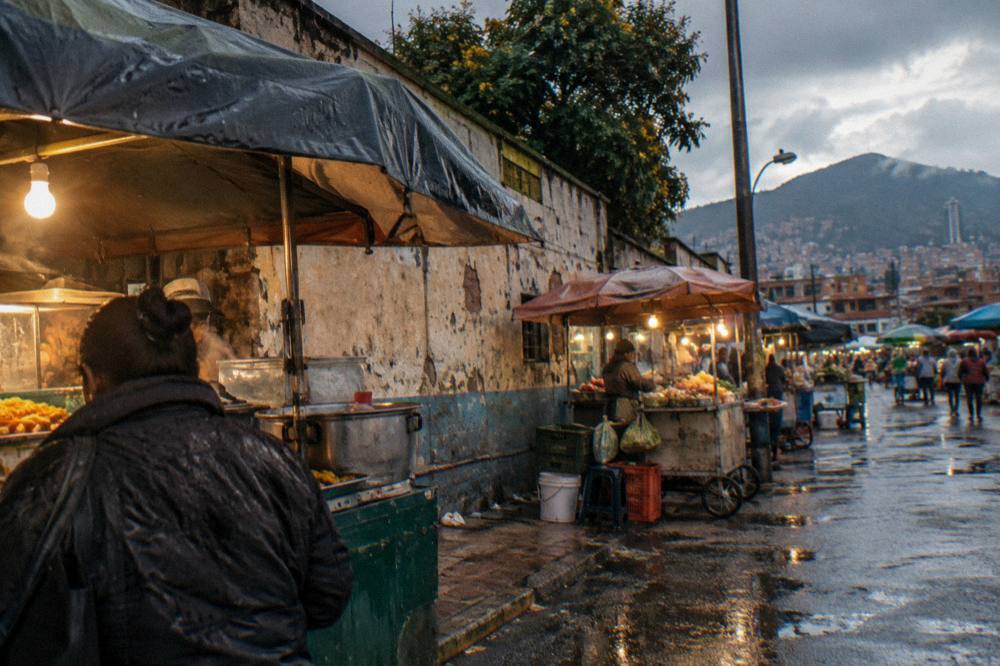
Lunch is where the day can swell. A tamal combo at a festival stall is 10,000 COP, but a sit-down ajiaco at a market plaza runs more: delivery menus in late 2026 showed a 16 oz ajiaco at 23,700 COP and a 24 oz at 33,900 COP, reported prices that give you the ceiling of a market lunch. The soup deserves its full context in our guide to ajiaco and where to eat it. If the day stretches to evening, one tejo club offers an hour of the national throwing game with two beers from 45,000 COP per person, and a craft beer at a brewpub runs about 80,000 COP a pint, which is the point where street food becomes a night out.
Whether you build that day yourself or hand it to a guide, these three walks cover the ground.
Common Questions About Bogotá Street Food
What Street Food Is Bogotá Known For?
Bogotá is known for griddled arepas, fried empanadas, bakery breads like pan de bono and almojábana, fresh fruit cups and juices, obleas with arequipe, and market-plaza dishes such as tamal and ajiaco. Reported single-item prices run about 4,000 to 5,000 COP at carts and bakeries.
Is Street Food In Bogotá Safe?
Apply the city's own advisory: buy from formal or authorised stalls, check packaging and labels, and avoid damaged or unlabeled items. Tap water in Bogotá is officially potable, though some visitors prefer bottled. No advisory guarantees every stall, so favour busy stalls cooking in front of you.
How Much Does Street Food Cost In Bogotá?
Reported prices run about 4,300 to 4,700 COP for bakery breads, 4,000 to 5,000 COP for juices, and 10,000 COP for a festival tamal combo with a hot drink and arepa or bread. A market ajiaco runs higher, around 23,700 to 33,900 COP for medium to large bowls.
Do I Need Cash For Street Food In Bogotá?
Yes, carry small notes. Carts and market stalls work in cash, and small denominations like 2,000, 5,000 and 10,000 COP notes make change simple. Contactless payment is common in restaurants but not at street stalls.
Should I Take A Guided Street Food Walk?
A guided walk helps if you are short on time, uneasy about stall-picking, or want dishes explained. Shared walks start from $17.71 per person, and the most reviewed food walk among those described here runs from $55 with 12+ tastings counted. Confident travelers can eat well independently.
Can Vegetarians Eat Bogotá Street Food?
Partly. Fruit cups, juices, arepas and obleas are generally meat-free, but arepas often carry cheese or butter and fried items share oil with meat. About 36 percent of the city's restaurants offer vegan or vegetarian options, but that does not extend to carts, so ask at the stall.