Colombian Fruits To Try In Bogotá: Lulo, Curuba, Granadilla And More
Colombia grows a startling range of fruit, and Bogotá's markets bring most of it up the mountain to one place. Here is what to look for, what each one tastes like, and how to eat it without guessing.
Short answer
Start with lulo, curuba, granadilla, uchuva, maracuyá and guanábana: six names that cover the range from sharp and citrus-like to perfumed and custardy. Paloquemao market, open Monday to Saturday from 4:30 to 16:30, is the easiest place to try them, and guided fruit tastings run from about $40 per person.
Bogotá sits at about 2,640 m, far above the tropical lowlands where most Colombian fruit actually grows, yet the city's markets receive the harvest daily. The result is one of the widest fruit selections of any capital in the Americas: dozens of names that rarely appear in a supermarket back home, sold by vendors who will usually cut one open on the spot. This guide covers the fruits worth learning before you go, how each one tastes, where to find them in Bogotá, and what a guided tasting adds over going alone.
If you want the short version: the market to visit is Paloquemao, the names to memorise are lulo, curuba, granadilla, uchuva, maracuyá and guanábana, and a guided fruit tasting starts at around $40 per person. If you have a free morning and a sense of curiosity, read on for the full picture. For everything else the site covers about the market itself, the Bogota Food Tours homepage collects the food-first guides in one place.
Why Colombia Has So Many Fruits
Colombia's geography, not marketing, explains the fruit aisle: the country spans Andean, Caribbean, Pacific, Amazon and Orinoco climates within a short flight of each other, so growers can produce tropical, highland and mid-altitude crops in the same week. Bogotá, as the hub, receives nearly all of it. That is why a single market stall can hold twenty unfamiliar species.
The variety is not a recent invention. Fruit has moved through Colombia's plazas de mercado for generations, and the markets themselves are city institutions: Paloquemao has operated for 54 years, and in October 2026 it hosted an opera performance for the first time in its history, a sign of how central the building is to the city's cultural life. The city's tourism office currently runs a Ruta Turística de las Plazas Distritales de Mercado, a market route that promotes the plazas for exactly this reason, as reported in October 2026.
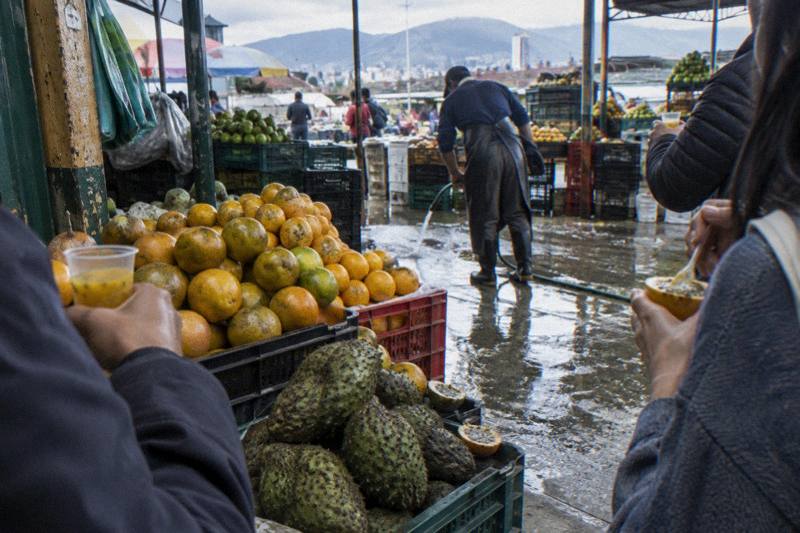
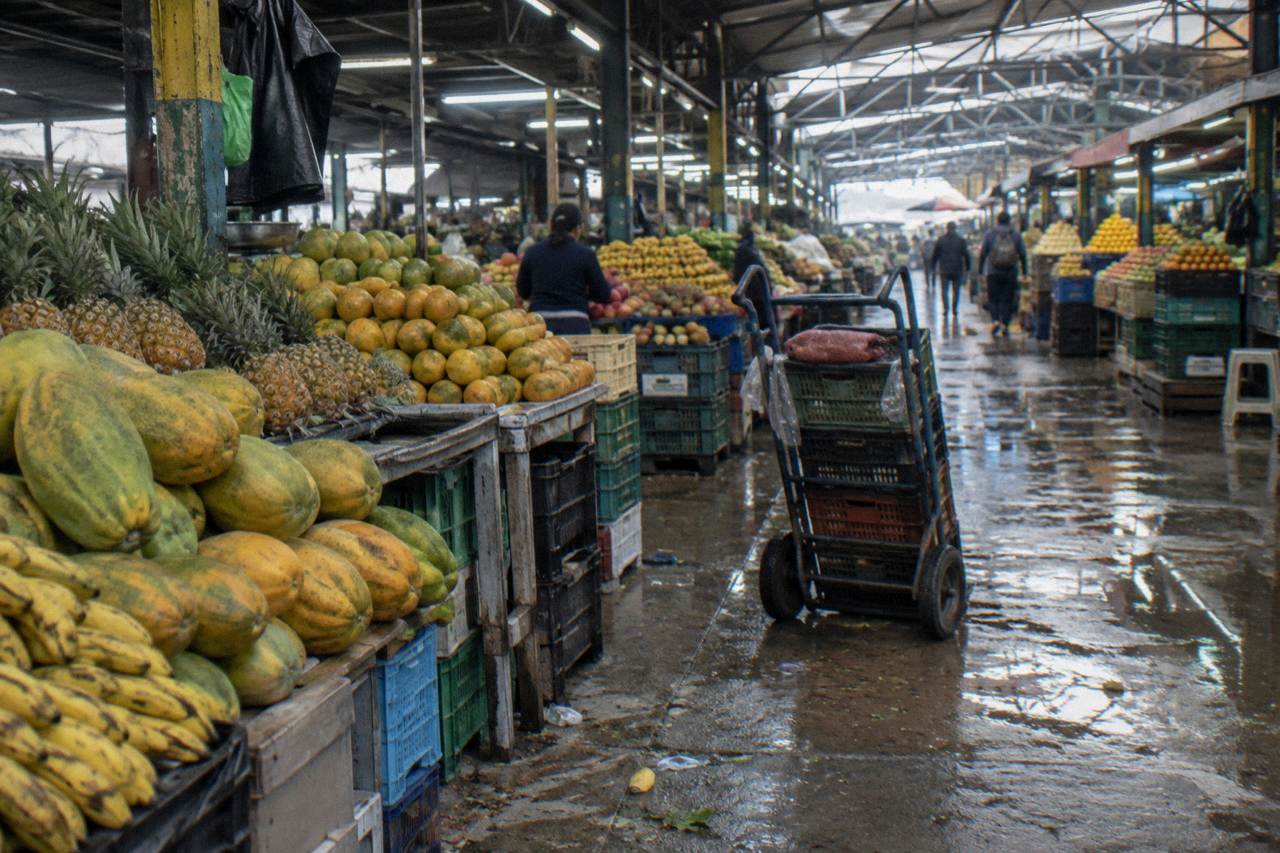
What surprises most visitors is that the familiar fruits are the minority. Alongside papaya, pineapple and banana sit borojó, chontaduro, copoazú, guanábana, lulo, mamoncillo and a long shelf of others. Vendors at Paloquemao's fruit alleys commonly offer tastes of exotic fruit like granadilla, lulo and uchuva in the early morning hours, when the wholesale trade is at its peak and the produce is freshest. The market thins after midday, which matters for planning: the fruit experience at Paloquemao is genuinely better early.
If you are building a wider market day, the Paloquemao market food guide covers the layout, and the Bogotá markets beyond Paloquemao guide maps the alternatives if your dates do not line up with the main plaza's schedule.
The Colombian Fruits To Know By Name
Learn these eight names and you will recognise most of what a Bogotá fruit stall shows you: lulo, curuba, granadilla, uchuva, maracuyá, guanábana, pitaya and chontaduro. Each occupies a distinct flavour slot, from bright and sour to dense and starchy, and together they explain why Colombians talk about fruit the way other countries talk about wine.
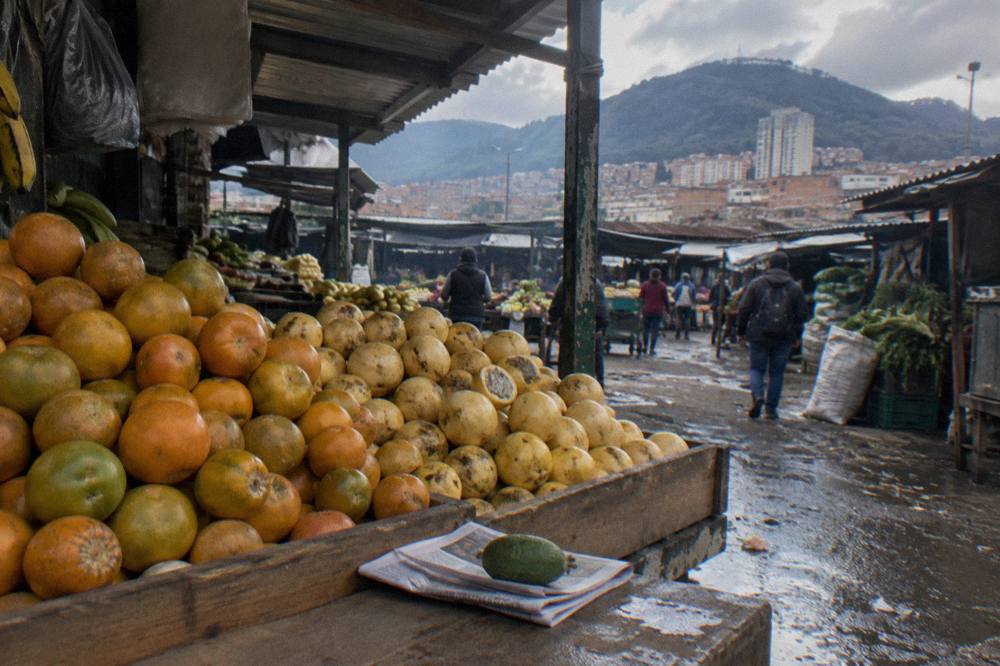
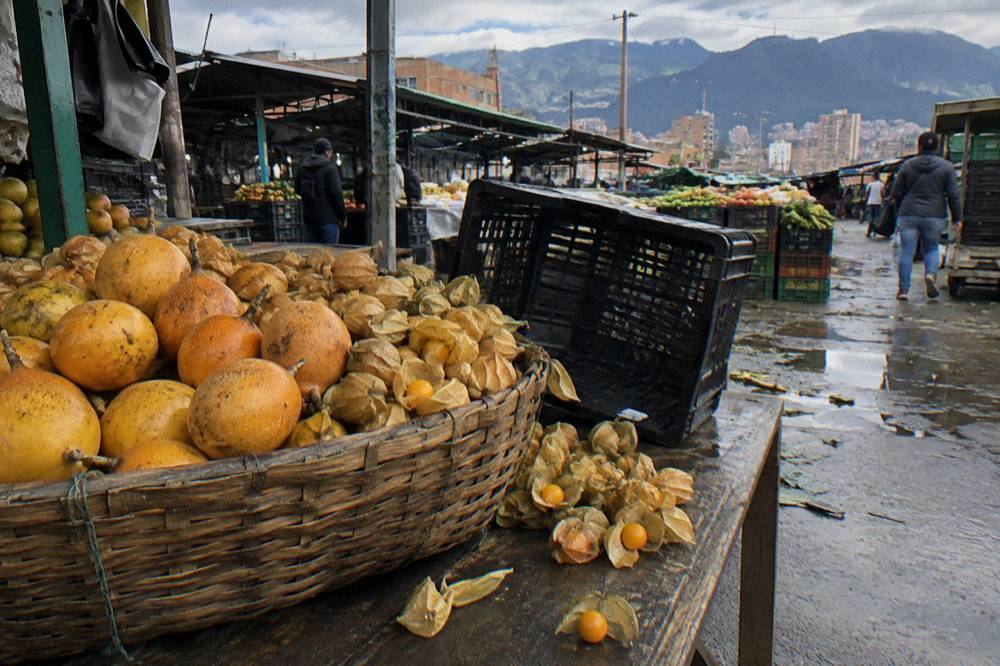
Lulo is the place to start. It looks like a small orange tomato with a fuzzy skin, and its juice, thick and green-gold when blended, is arguably the country's most requested fruit drink. The taste is sharp and citrus-like with a note somewhere between lime, rhubarb and kiwi; it is almost never eaten raw off the shelf because of its acidity, but as juice with a little sugar it is the flavour most visitors remember. Curuba, sometimes called banana passion fruit, is its perfumed opposite: an elongated yellow fruit with jelly-like seeds inside and a floral, almost tropical aroma that works beautifully blended with milk. Granadilla is the gentle one, a hard orange shell you crack open by hand to eat the sweet pulp and soft seeds with a spoon, no knife required. It is the fruit Colombian parents hand to children, and it travels well.
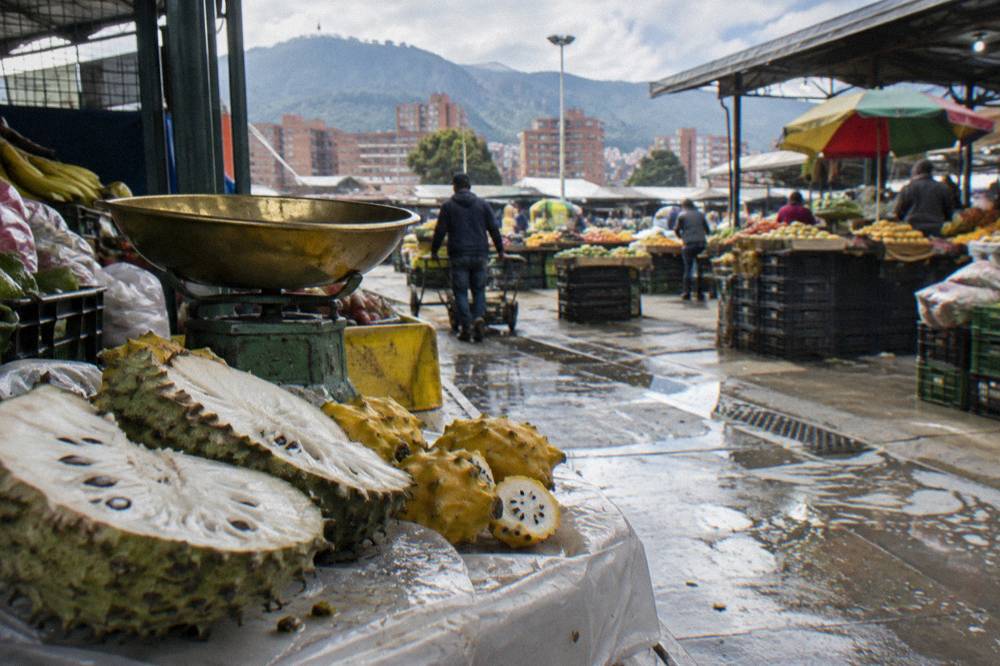
Uchuva is the small golden berry wrapped in a papery husk, tart and bright, eaten by the handful. Maracuyá is the local passion fruit, more sour than sweet, used mainly for juice and desserts. Guanábana, soursop, is the heavyweight: a spiky green fruit with white, fibrous, custard-sweet flesh that flavours juices and ice creams across the city. Pitaya, the yellow Colombian dragon fruit, delivers mild sweetness with a kiwi-like texture. Chontaduro is the outlier, a dense orange palm fruit sold boiled with salt, more starch than juice, and a Pacific-coast street snack rather than a dessert fruit.
The eight fall into natural families, and grouping them this way makes a stall less intimidating: the sour juice fruits, the spoon fruits, the snack fruits and the oddity. Use the table below as your mental shelf before you shop or join a walk.
| Family | Fruits | What they have in common |
|---|---|---|
| Sour juice fruits | Lulo, maracuyá, uchuva | High acidity, almost always blended and sweetened |
| Perfumed blender fruits | Curuba, guanábana | Floral or creamy, traditionally blended with milk |
| Spoon fruits | Granadilla, pitaya | Opened by hand or halved, pulp eaten as is |
| Street snack fruits | Chontaduro | Starchy, boiled with salt, eaten warm |
A guided tasting puts all of this in order in a single morning, which is the appeal for most first-time visitors. The market food walks compared here include a Paloquemao fruit and snack walk rated 4.9 across 71 reviews, from $82 per person with the price varying by group size, alongside lighter and shorter options.
How Each Fruit Actually Tastes
Expect a spread from sharply acidic to dessert-sweet: lulo and maracuyá sit at the sour end and are almost always sweetened into juice, granadilla and guanábana are naturally sweet enough to eat as they are, and uchuva, pitaya and curuba fall in the middle. Chontaduro is not sweet at all, it is starchy and savoury, eaten warm with salt.
The table below gives a practical reading of each fruit so you can order with some idea of what is coming. Treat it as a flavour map rather than a verdict: ripeness, variety and the vendor's hand with sugar all shift the result. A juice that one stall pours tart another will pour sweet, so if your first lulo tastes too sharp, the answer is to order it again somewhere else rather than write it off.
| Fruit | Looks like | Taste profile | How it is usually served |
|---|---|---|---|
| Lulo | Small fuzzy orange sphere | Sharp, citrus-like, rhubarb note | Juice with sugar, rarely raw |
| Curuba | Long yellow pod | Floral, perfumed, mild acidity | Juice blended with milk |
| Granadilla | Hard orange shell, crackable by hand | Sweet, mild, jelly pulp | Eaten raw with a spoon |
| Uchuva | Golden berry in papery husk | Tart, bright, pops when bitten | Eaten raw by the handful |
| Maracuyá | Purple or yellow passion fruit | Very sour, aromatic | Juice, desserts |
| Guanábana | Large spiky green fruit | Sweet, creamy, fibrous custard | Juice, ice cream |
| Pitaya | Yellow dragon fruit | Mildly sweet, kiwi texture | Eaten raw, halved |
| Chontaduro | Small dense orange palm fruit | Starchy, savoury, dry | Boiled with salt, street snack |
Two orderings tips carry most of the weight. First, when in doubt at a juice stand, ask for a jugo natural rather than a flavored syrup mix: the whole point in Bogotá is that the fruit itself is the ingredient. Second, the fruits that reward a guided tasting most are the ones with a trick to them, granadilla's shell, chontaduro's boiling, curuba's seeds: a guide who opens one of each in front of you saves a lot of puzzled handling.
Where To Find These Fruits In Bogotá
Paloquemao is the single best stop, open Monday to Saturday from 4:30 to 16:30 and Sundays and holidays from 5:00 to 16:30, with the flower section until 11:00. Alternatives include La Perseverancia for traditional food stalls, the Usaquén weekend flea and food market, and the nocturnal Samper Mendoza herb market on Monday and Thursday nights.
Paloquemao's hours reward early risers. The pre-dawn to mid-morning window is when trucks unload and vendors hand out tastes of granadilla, lulo and uchuva; by early afternoon the energy thins, and on Sunday the market closes at 16:30. The plaza's own site lists these hours, and the city's tourism office carries the same information on its Paloquemao page. For exact stall-by-stall questions, the market's contact page is the source to check.
La Perseverancia, open Monday to Friday from 8:00 to 16:00 and weekends from 6:00 to 17:00, is the traditional-food plaza: family stalls serving ajiaco, lechona and fritanga, with fruit available but not the headline. Usaquén's flea and food market runs Saturdays, Sundays and holiday Mondays from 9:00 to 17:30 on Carrera 6A between Calles 119 and 120A, with stalls selling arepas, fresh-cut fruit with salt and lime, empanadas and hot chocolate, a pleasant weekend option if Paloquemao feels like too much city. Samper Mendoza is the specialist oddity: a nocturnal wholesale hub for more than 500 plant species, open Monday and Thursday nights from 21:00 to 5:00, with a remarkable 391 species documented in one plaza, 201 of them native to Colombia, according to a Bogotá tourism post in October 2026. The city's market route coverage names both plazas among seven worth discovering.
| Market | Reported hours | Fruit reason to go |
|---|---|---|
| Paloquemao | Mon to Sat 4:30 to 16:30, Sun and holidays 5:00 to 16:30, flowers until 11:00 | Fruit alleys, tasting culture, guided walks |
| La Perseverancia | Mon to Fri 8:00 to 16:00, weekends 6:00 to 17:00 | Traditional dishes alongside fruit stalls |
| Usaquén flea and food market | Sat, Sun and holiday Mondays 9:00 to 17:30 | Cut fruit cups, arepas, hot chocolate |
| Samper Mendoza | Mon and Thu nights 21:00 to 5:00 | Nocturnal herb and plant wholesale, 391 species documented |
Guided options cover most of these formats. The Shared Tour of Colombian Exotic Fruit at Paloquemao Market runs 3 hours from $50.17 per person, rated 4.6 across 32 reviews, a good mid-priced choice if you want the shared-walk format.
Ordering Fruit As Juice And Other Street Formats
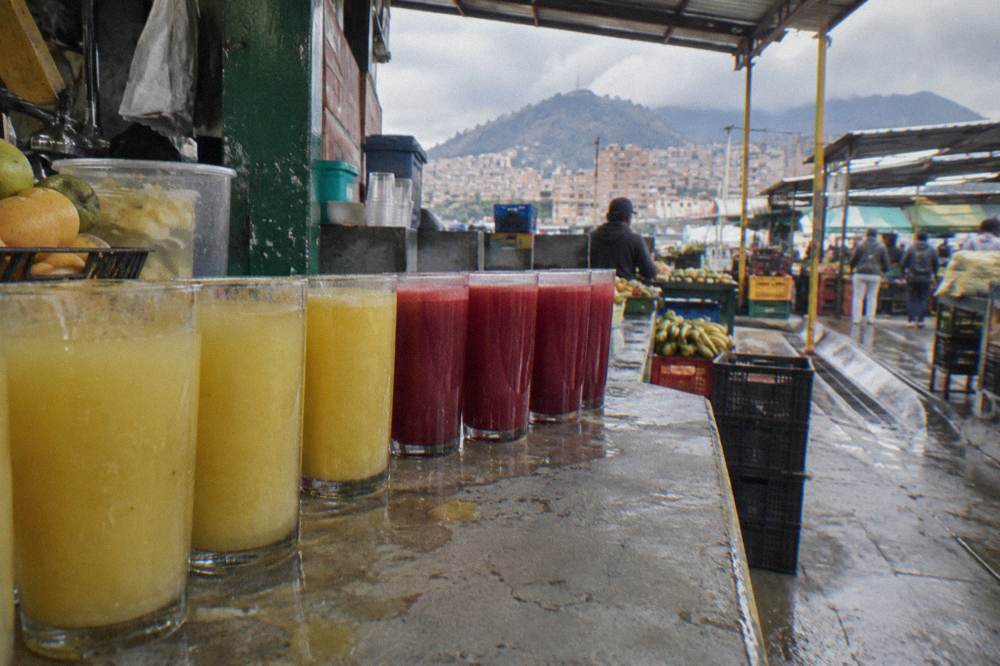
Juice is the default Colombian way to eat unfamiliar fruit, and it is the smart first order: nearly every stall blends to order, you can watch the fruit go in, and reported street prices run from 4,000 COP for a lulo juice to 5,000 COP for curuba with milk at La Candelaria carts. Fresh-cut fruit cups and boiled chontaduro round out the street formats.
Reported prices from a La Candelaria street cart in August 2026 put lulo juice at 4,000 COP and curuba blended with milk at 5,000 COP; treat those as reported street-level figures rather than fixed rates, since prices vary by neighborhood and season. A juice at a sit-down café costs more, and tasting fees on guided walks are included in the walk's own price, so the comparison is not like for like. Everything else covered here is indexed on Bogota Food Tours.
The ordering vocabulary is short. Jugo natural means blended fresh fruit; con agua mixes it with water, con leche with milk; en agua or en leche is how you will hear it asked. Curuba almost always arrives with milk, lulo almost always with water and sugar, and guanábana goes either way. If you want the fruit itself rather than the drink, ask for a copa de fruta, a cup of cut fruit, sometimes served with salt and lime as they do at the Usaquén weekend stalls. Chontaduro comes from a heated glass box, boiled and salted, usually with a small cup of its own cooking broth in Pacific-coast style.
| Phrase | What it means | When to use it |
|---|---|---|
| Jugo natural | Fresh fruit blended to order | Any juice stand, the default good order |
| En agua | Juice blended with water | Lulo, maracuyá, uchuva |
| En leche | Juice blended with milk | Curuba, guanábana |
| Copa de fruta | Cup of cut fresh fruit | When you want to chew, not sip |
| Maduro | Ripe, ready today | Buying whole fruit to eat soon |
| Verde | Underripe, needs days | Buying whole fruit for later in the week |
One practical note on timing: fruit juice is also the standard accompaniment to a Bogotá breakfast, and the Bogotá breakfast guide pairs the two, changua or calentado plus a jugo, if you are planning early mornings around market hours.
What A Guided Fruit Tasting Adds
A guided tasting buys two things: someone who names and cuts each fruit in sequence, from sharp to sweet, and access to stalls a first-time visitor would walk past. The tours compared here run from $40 to $191 per person, from a shared gastronomist-led walk to a private market circuit, so the format spans budget and premium.
The pricing spread is wide enough to be worth spelling out. At the accessible end, the Discover 20 Fruits & Coffee with a Gastronomist walk costs $40 per person for 3 hours and samples around twenty fruits plus coffee; it is a newer listing with a small review pool, so judge it on its description rather than its rating. The shared exotic-fruit walk at $50.17, rated 4.6 across 32 reviews, sits in the middle. The featured Paloquemao Market Food Tour, from $82 per person varying by group size and rated 4.9 across 71 reviews, folds the fruit alleys into a broader market walk with local snacks. At the premium end, private tours run from $103 to $191 per person.

The private format earns its price for some travellers. The Private Paloquemao Food & Fruit Market Tour promises 25 or more tastings in 3 hours, from $103 per person varying by group size, and it rates 5.0 across 19 reviews, a small but positive pool. For couples or small groups who want the guide's full attention and a slower pace through the fruit alleys, that is the standard choice; the private food tour guide weighs when the premium is worth paying across all formats.
The Fruit Tour, from $191 per person with the price varying by group size, is the deepest-pocketed option in the group, rated 4.8 across 5 reviews. Where it differs is scope: the listing positions it as a full best-of-market experience rather than a tasting sprint, which suits a food-focused traveller with one free day.
Buying Fruit To Take Back To Your Hotel
Yes, you can buy whole fruit at Paloquemao and carry it out: granadilla and uchuva travel best thanks to their protective shells and husks, lulo and maracuyá travel fine for a day or two, and cut or peeled fruit should be eaten within hours. Ask the vendor which fruits are ready to eat today versus in three days, that judgement is their trade.
The rules of thumb are simple. Buy fruit you can open without a knife if you have no kitchen: granadilla cracks under a thumb, uchuva sheds its husk. If your hotel room has no fridge, favour thick-skinned fruit and eat soft fruit like guanábana the day you buy it. Wash everything in bottled or boiled water if you prefer, though Bogotá's tap water is officially potable and some visitors still choose bottled, both positions are reasonable. Ask for fruit maduro, ripe, if you want it today, and verde if you are buying for later in the week; vendors handle that question daily.
One honest boundary: do not plan to carry fresh fruit through international airports. Agricultural restrictions in most destination countries confiscate it, so the fruit you take home from Bogotá should be the memory and, where permitted, processed products like jams or pulps. If a purchase matters, ask at the stall what travels.
A private walk also works well for a shopping-heavy morning, since the guide can hold the pace while you buy. The Bogotá Paloquemao Market Private Tour with Tastings runs 3 hours for $112 per person; it is a newer listing with only a handful of reviews, so read the inclusions on the booking page before committing.
Planning Your Fruit Morning Around Market Hours
Arrive at Paloquemao before 10:00 on a weekday for the fullest market and the most generous tasting culture, avoid Sunday if you also want the flower hall, and leave the afternoon free, the plaza closes at 16:30 on weekdays and 16:30 on Sundays and holidays. A guided morning walk slots neatly before lunch, since all three shared tours run about 3 hours.
The early window is not folklore. Reports from the market describe peak wholesale energy from pre-dawn to around 10:00 on weekdays, with trucks unloading and vendors offering tastes as they sort their produce; the aisles are calmer and the selection thinner after midday. Weekends shift the rhythm: Saturday runs the full schedule, while Sunday and public holidays close at 16:30 and the flower section, a genuine side attraction, only runs until 11:00 daily. If flowers and fruit are both on your list, morning is the only slot that delivers both.
Weather barely matters for this plan, which is a real advantage in a city with rainy seasons in April to May and October to November: the market is under cover. Current outlooks even point to a drier El Niño pattern into early 2027, but the safe assumption in Bogotá is always a possible afternoon shower, one more reason to put the market first. If you are deciding between a morning and an evening food experience generally, the morning or evening food walk guide makes the case that mornings own the market formats outright.
Compare prices and inclusions, then check availability on the operator's booking page, since schedules follow the market's own hours.
Common Questions About Colombian Fruits
What Is The Most Popular Colombian Fruit Juice?
Lulo juice is the one Colombians order most often away from home, sharp and citrus-like with a rhubarb note, almost always served sweetened. Curuba with milk runs it close, softer and more perfumed.
What Is The Difference Between Granadilla And Maracuyá?
Both are passion fruits, but granadilla is sweet and mild with a crackable orange shell you eat with a spoon, while maracuyá is strongly sour and usually ends up in juice or desserts rather than eaten raw.
Can You Eat Colombian Fruit Skin?
Generally no: lulo, maracuyá, guanábana and pitaya skins are discarded and the pulp eaten. Granadilla's shell is cracked and discarded, and uchuva's papery husk is peeled off. Chontaduro is boiled before eating.
Where Is The Best Place To Buy Fruit In Bogotá?
Paloquemao market, open Monday to Saturday from 4:30 to 16:30 and Sundays and holidays from 5:00 to 16:30, with the best selection and tasting culture before 10:00 on weekdays. Usaquén's weekend market is a pleasant Sunday alternative for cut fruit and snacks.
Is A Guided Fruit Tour Worth It In Bogotá?
If you want to try many fruits in one morning with someone who names and opens each one, yes: guided tastings run from $40 to $191 per person, and the featured Paloquemao walk, from $82 varying by group size, rates 4.9 across 71 reviews. If you only want two or three fruits, going alone works fine.
Can I Bring Colombian Fruit Home On The Plane?
Not as fresh fruit through international airports: agricultural controls in most countries confiscate it. Eat your fill in Bogotá and take home processed products like jams or pulps where your destination allows them.