Ajiaco Bogotano: Where To Eat Bogotá's Signature Soup
Ajiaco santafereño is the dish most visitors want to taste first in Bogotá: a chicken soup built on three kinds of potato and the guascas herb, served with cream, capers, avocado and rice. Here is what it is, where to eat it, and how a guided tasting walk works it in.
Short answer
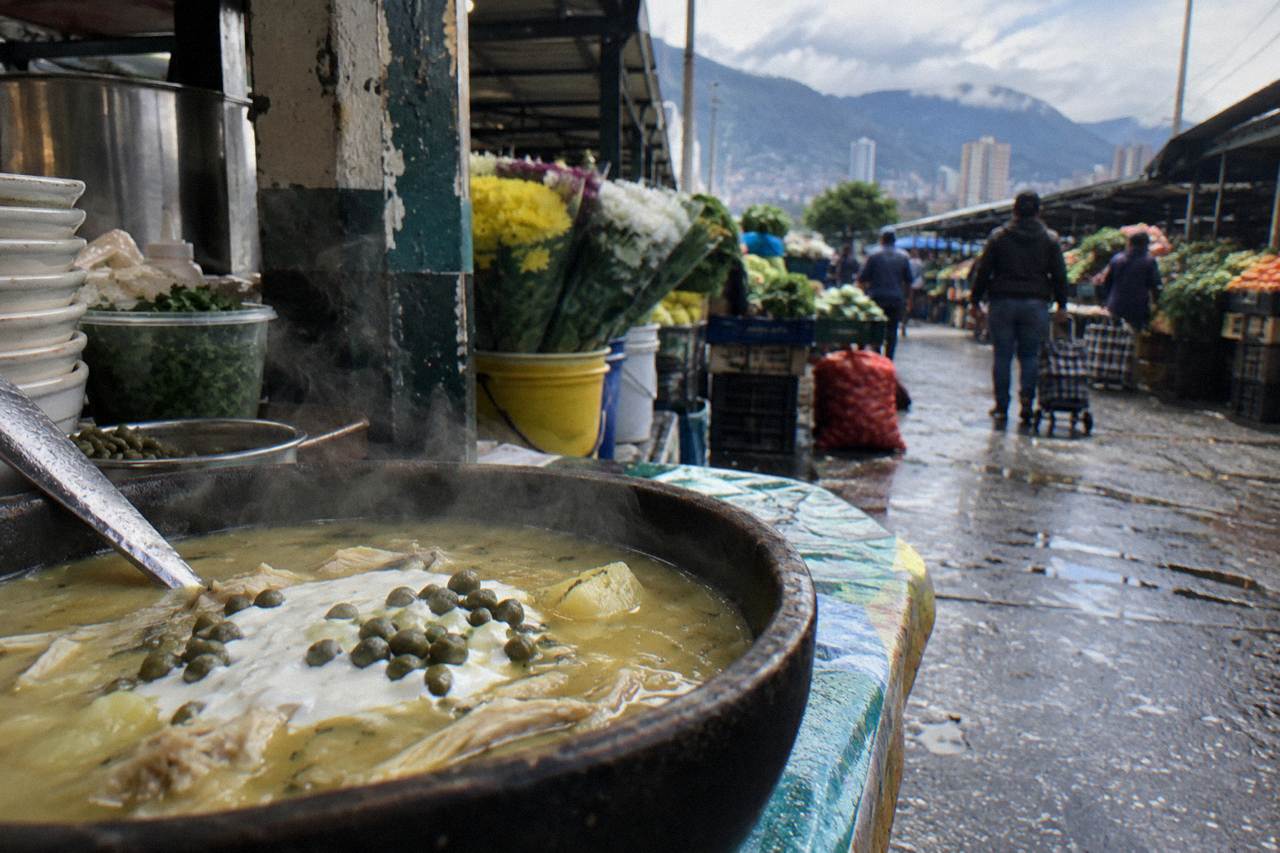
Ajiaco is Bogotá's signature soup: chicken broth thickened with three potato varieties and flavoured with guascas, served with cream, capers, avocado, rice and corn on the side. You can eat it at the city's market plazas, including Plaza Distrital de Mercado 12 de Octubre, or on guided food walks. Reported market-adjacent prices run about 23,700 COP for a medium bowl.
Few dishes carry a city's identity the way ajiaco carries Bogotá's. Ask a local what a first-time visitor should eat and the answer comes before the question is finished: ajiaco santafereño, the hearty chicken soup that belongs to the highland plateau and nowhere else quite the same way. It is a cold-weather dish from a city at about 2,640 m, where the afternoon fog rolls in and a bowl of potato-thickened broth is not comfort food but ordinary lunch. This guide covers what ajiaco actually is, what goes into the pot, how it is served, where to find it in Bogotá, and how guided food walks work it into their routes. For the wider picture of local dishes, see the companion page on traditional Bogotá dishes.
What Is Ajiaco Bogotano?
Ajiaco santafereño is a chicken and potato soup specific to Bogotá and the surrounding Sabana highlands, defined by three potato varieties cooked down together and by guascas, an herb that gives the broth its distinctive flavour. It is served with accompaniments added at the table rather than in the kitchen, which is part of the ritual. It is a dish of altitude and cold evenings, eaten year-round.
The name itself is contested. Soups called ajiaco exist elsewhere in Latin America, including a quite different Cuban stew, but the santafereño version belongs to Bogotá and is the one Colombians mean when they recommend it to travellers. What separates it is not just the ingredient list but the method: the potatoes are chosen so that some break down completely and thicken the broth while others hold their shape, giving the soup body without any cream or flour added at the stove.
It is also a genuinely local dish in a way many famous foods are not. The potato varieties traditionally used grow in the cold highlands around the capital, and guascas, sometimes called galinsoga, is a weedy herb that other cuisines ignore. Bogotá's market plazas sell both in quantity, and families cook ajiaco at home on weekends. That domestic life matters for visitors, because it means the best bowls are often found where locals eat, at market food halls rather than tourist restaurants. For more on those markets, the guide to Bogotá's markets beyond Paloquemao maps the main plazas.
This guide points to kinds of place, market plazas, traditional restaurants and guided walks, rather than naming a single winner. Ajiaco changes from kitchen to kitchen, so trying a few bowls across Bogotá is the better plan.
What Goes Into Ajiaco: Three Potatoes, Guascas And Chicken?
The core is chicken on the bone, three potato varieties that each behave differently in the pot, and dried guascas. Pasty papa criolla dissolves and thickens, papa sabanera breaks down partly, and waxy papa pastusa holds its pieces. Corn on the cob goes in near the end. Cream, capers and avocado are served alongside, not cooked in.
The potato logic is the engineering of the dish. A cook needs one potato that disappears into the broth entirely, one that half-melts, and one that survives as visible chunks, so every spoonful has both silk and bite. The yellow papa criolla, small and intense, does the thickening. That is why ajiaco's colour is golden and its texture is almost creamy before anything is added at the table.
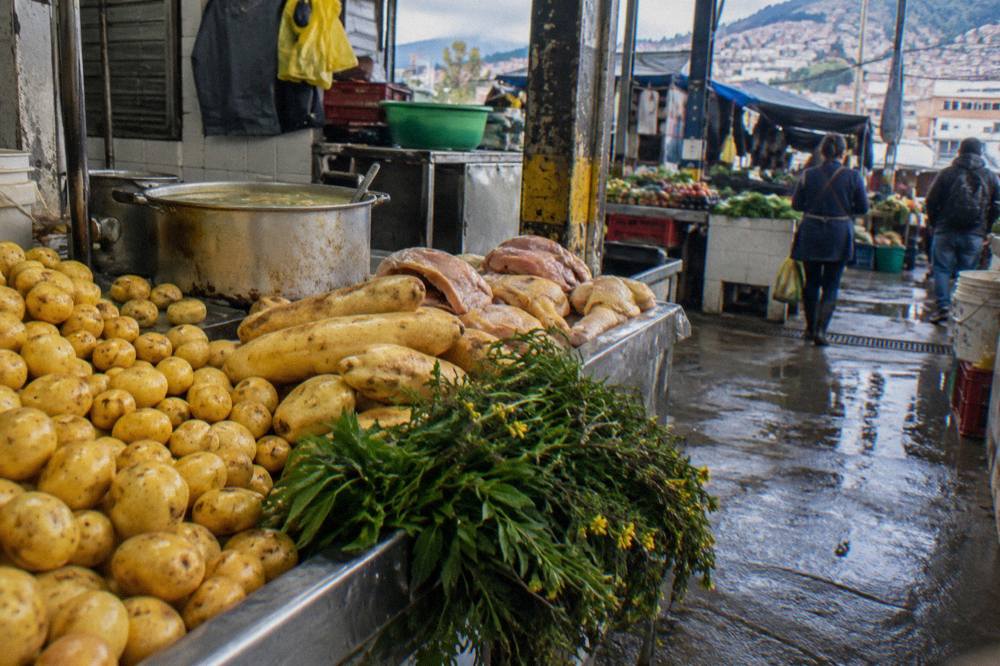
Guascas is the flavour you cannot substitute. Dried and crumbled into the broth in the last stretch of cooking, it gives a grassy, faintly smoky note that people struggle to name until they learn the herb. It is sold by the bag in every market plaza in the city. Chicken is poached whole or in large pieces, then shredded and returned to the pot, and a piece of corn on the cob per diner is traditional, its sweetness balancing the herb.
| Ingredient | Role In The Pot | Notes |
|---|---|---|
| Chicken (whole or large pieces) | Base protein, poached then shredded | Dark meat is traditional for flavour |
| Papa criolla | Dissolves fully, thickens the broth | Small yellow highland potato |
| Papa sabanera | Partially breaks down | Adds middle texture |
| Papa pastusa | Holds its shape | Waxy, gives visible chunks |
| Guascas (dried herb) | Signature flavour, added late | Not easily substituted |
| Corn on the cob | Sweetness, added near the end | One piece per diner is typical |
The accompaniments are where first-timers get confused, because the bowl arrives with side plates. Cream is drizzled in, capers are dropped in by the spoonful, avocado slices rest on the rim, and a scoop of white rice may go straight into the soup or beside it. There is no correct order; locals mix freely. Table salt and more guascas are often on hand.
If you would rather taste this dish with someone who can narrate it, a guided tasting walk through the historic centre is the usual route. The three walks below are the street-food walks that most often serve this reader, led by the most reviewed food walk in the city, rated 5.0 across 714 reviews.
The featured walk among those three, the Viejo Bogota Food Tour, runs 4 hours with more than 12 tastings from $55 per person, and its operator's tour page lists the current route and inclusions. Whether ajiaco appears on a given departure depends on the day's stops, so check the booking page before counting on it. A second option, the Bogotá Food Experience, runs 4 hours from $47.15 per person and is rated 4.9 across 615 reviews; the Food Tour in La Candelaria runs 3 hours from $63 per person, rated 4.9 across 72 reviews, with the price varying by group size.
How Is Ajiaco Served And Eaten?
Ajiaco arrives as a deep bowl of golden broth with shredded chicken, potato chunks and a corn piece, flanked by small dishes of cream, capers, avocado and rice that each diner adds themselves. It is eaten hot, usually at lunch, the main meal of the Bogotá day, and the mixing at the table is part of the experience.
Lunch in Bogotá is not a sandwich at a desk. It is the day's central meal, often a fixed-price menu with soup, main, drink and a small dessert, and ajiaco is the Sunday-and-holidays centrepiece of that culture. Many families eat it after a late morning, and restaurants that serve it by the pot advertise it with hand-written signs. Visitors should expect the bowl to be genuinely filling: with rice added, it is a complete meal, not a starter.
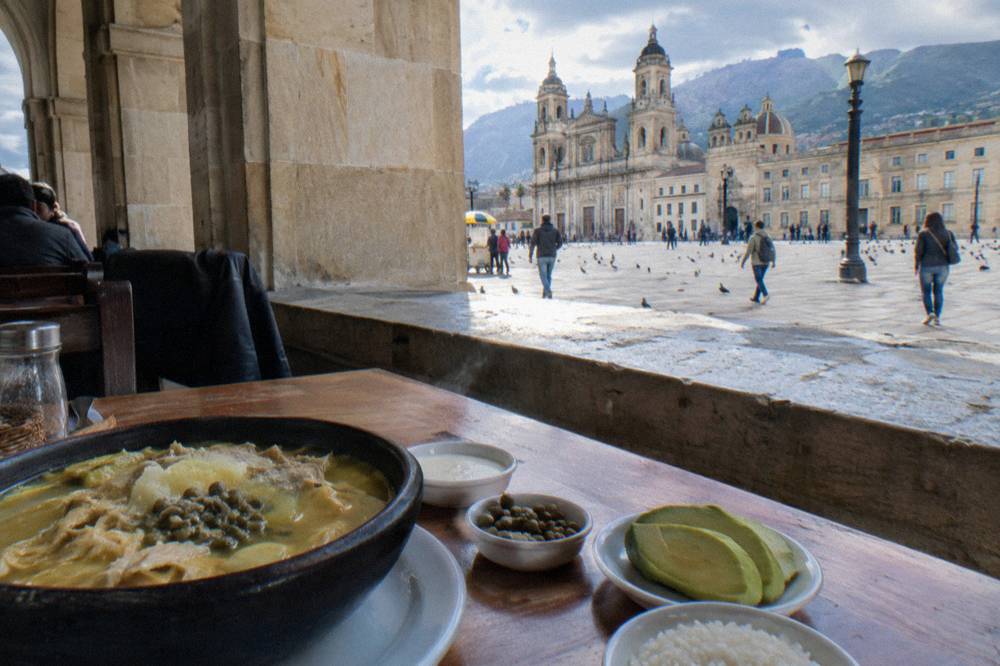
The corn is the part that surprises people. It is a large-kernel field corn, chewier and starchier than sweet corn, meant to be gnawed from the cob between spoonfuls. The capers cut the richness, the cream rounds the herb's edge, and the avocado, usually the small, creamy local kind, melts into the hot broth. Nobody will look twice if you add everything at once.
A bowl also sits well inside the rhythm of a guided walk. On a food walk through La Candelaria, a hot soup stop is usually the mid-point anchor between lighter street tastes, and a guide handles the ordering, the table etiquette and the story of the dish, which is worth having when a menu offers three sizes you cannot read. If a walk with that structure appeals, the question is simple.
Free cancellation before departure is offered on the featured walk, so booking ahead for a fixed day costs little flexibility. Dietary needs are worth messaging to the operator before booking, since none of the tour listings describes a vegan or gluten-free option.
Where Can You Eat Ajiaco In Bogotá?
The most reliable places are the city's market plazas, where family-run food halls serve ajiaco alongside other traditional dishes. Colombian tourism reporting from October 2026 highlights five plazas for ajiaco santafereño, including Plaza Distrital de Mercado 12 de Octubre in Barrios Unidos. Traditional restaurants in La Candelaria and Chapinero also serve it daily.
Market plazas are where Bogotá eats its own food. The 2026 reporting names five plazas for ajiaco, with the 12 de Octubre plaza in Barrios Unidos described as a standout, open on Monday, Tuesday, Friday and Saturday from 7 a.m. to 4 p.m. as reported. The same reporting highlighted the "Días de Ajiaco Santafereño" festival format, which ran 20 to 23 November 2025 with plaza and restaurant participation, so a November visit may catch a repeat edition; check the institute's festival announcement for the current year.
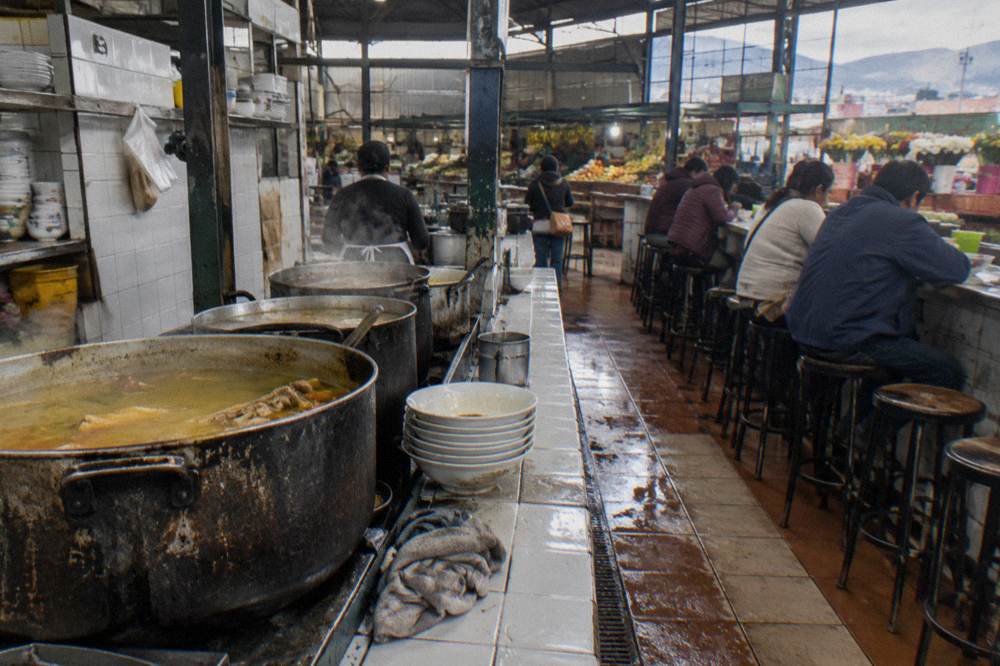
La Perseverancia, the plaza in the neighbourhood of the same name, is another traditional-food stop: Visit Bogotá describes family-run stalls there serving ajiaco, lechona, mute santandereano, mondongo and fritanga, open Monday to Friday 8 a.m. to 4 p.m. and weekends 6 a.m. to 5 p.m. It features in the city's 2026 market-plaza tourism route for traditional food, per Bogotá's official plaza guide. A guided option exists for readers who want the plaza experience narrated: the Bogota Shared Gastronomy Tour in the Historic Center runs 3 hours, rated 4.9 across 291 reviews, and its listed price of $15 is a guide fee only, with tastings at about US$12 extra on the day.
| Plaza | Reported Hours | Known For |
|---|---|---|
| 12 de Octubre (Barrios Unidos) | Mon, Tue, Fri, Sat 7 a.m. to 4 p.m. (reported) | Named for ajiaco santafereño in 2026 reporting |
| La Perseverancia | Mon to Fri 8 a.m. to 4 p.m., weekends 6 a.m. to 5 p.m. | Family stalls: ajiaco, lechona, mondongo, fritanga |
| Paloquemao | Mon to Sat 4:30 a.m. to 4:30 p.m., Sun 5 a.m. to 4:30 p.m. | Fruit and flowers as much as food halls |
| Usaquén Sunday market | Sat, Sun, holiday Mon 9 a.m. to 5:30 p.m. | Arepas, fresh fruit, empanadas, hot chocolate |
Restaurants are the second option. Traditional restaurants across La Candelaria, Chapinero and the centre serve ajiaco daily, often advertised outside, and the historic La Puerta Falsa near the cathedral has served traditional dishes since 1816, best known for chocolate santafereño rather than ajiaco itself. No trustworthy ranking of ajiaco restaurants exists, so treat any "best bowl in town" claim as one writer's opinion.
What Does A Bowl Of Ajiaco Cost?
Delivery-menu listings in Bogotá show a medium 16 oz ajiaco at 23,700 COP and a large 24 oz at 33,900 COP, reported from current app menus, while combos of two large soups with two lemonades run about 78,300 COP. Restaurant prices vary; at the plazas, expect the cheapest bowls in the city.
Those app prices are for delivery from dedicated ajiaco kitchens, not restaurant dining, but they set a useful floor: a medium bowl costs roughly the price of two TransMilenio rides. At the time of reporting, 1 USD was about 3,183 COP, so the medium bowl works out near seven US dollars, though exchange rates move and you should check the current rate before converting mentally.
| Item (delivery menus, reported) | Price In COP | Approx. Basis |
|---|---|---|
| Ajiaco mediano, 16 oz | 23,700 COP | Single bowl |
| Ajiaco grande, 24 oz | 33,900 COP | Single bowl |
| Combo: 2 grandes + 2 limonadas | 78,300 COP | Two people |
On a guided walk, of course, you are not paying per bowl; you are paying for a route of tastings. The walks described here range from $47.15 per person for the 4-hour Bogotá Food Experience to $63 per person for the 3-hour La Candelaria walk (price varies by group size), with the featured 4-hour Viejo Bogota walk from $55. What any given walk tastes on a given day is on its booking page, and ajiaco is never guaranteed unless the listing's stops name it.
When Is The Best Time Of Year For Ajiaco?
Any time, because Bogotá is cool year-round, but the dish peaks culturally in the rainy months and the festival calendar around November and December. The "Días de Ajiaco Santafereño" ran 20 to 23 November 2025 across plazas and restaurants, and December's tamal festival across 17-plus plazas, 5 to 8 December 2026, carries the same market-food energy.
Bogotá's weather is remarkably stable for a city with a soup culture: two rainy seasons, April to May and October to November, with afternoon showers, and daytime temperatures that feel autumn-like all year. The 2026 to 2027 outlook adds a wrinkle: forecasters give a strong El Niño more than 90 percent probability for late 2026 into early 2027, expected to bring drier, sunnier days and colder nights. Colder nights suit ajiaco perfectly.
The November food calendar is worth building a trip around. The ajiaco festival format of November 2025 drew plaza and restaurant participation across the city, and if it repeats in November 2026 it will be the single best window to taste many versions in one week. Later in the season, the Festival del Tamal runs 5 to 8 December 2026 across more than 17 plazas with a tamal, hot drink and arepa combo at 10,000 COP as reported, which makes a satisfying bookend for a food-first visit; more on that in the guide to tamales, lechona and Sunday food in Bogotá.
For readers who want to cook rather than only eat, a cooking class with a market visit is the deeper option. One such listing, a 4-hour Colombian cooking class with market visit from $90 per person, includes market shopping before the cooking; its review pool is too small for a rating claim, so judge it on the itinerary.
How Do Guided Food Walks Fit Ajiaco In?
Guided walks in the historic centre build their routes around dishes visitors ask for by name, and ajiaco sits alongside arepas, tamales and coffee in that conversation. Whether it appears depends on the day's stops, which the operator sets; check the booking page's stop list before assuming it. Only listings that name a stop can be said to include it.
This distinction matters more than it sounds. Bogotá's food walks sell tastings, not à la carte menus, and routes shift with opening hours and group size. Each booking page publishes its stop list and inclusions, and that page, not a review or a blog post, is the source for what a walk tastes. A guide still adds something a solo plaza visit does not: portion pacing across a multi-stop route, the story behind guascas, and a fixer for the Spanish-only menu boards at market halls.
For readers comparing the formats, the three walks below span the price range of the city's shared street-food walks, from $47.15 to $63 per person, with the most reviewed option at 714 reviews anchoring the group.
A mid-format alternative is the Bogotá: True Colombian Walking Tour with Local Snacks, 2 to 3 hours from $54.68 per person, rated 4.9 across 130 reviews, which pairs a city walk with snack stops rather than a full tasting menu. For a longer, table-centred day, Bogota's Gastronomic Wonders runs 4 hours from $122 per person with the price varying by group size, rated 4.7 across 32 reviews, and leans toward sit-down traditional dishes of exactly the ajiaco type; whether ajiaco itself is served is on its booking page.
Can You Make Ajiaco At Home?
Yes, and the ingredient that matters most is the one hardest to find abroad: guascas, sold by the bag in every Bogotá market plaza and in Latin shops elsewhere. The three-potato structure can be approximated with a thickening potato, a waxy potato and freeze-dried papa criolla, which some exporters sell. A market-visit cooking class teaches the real method.
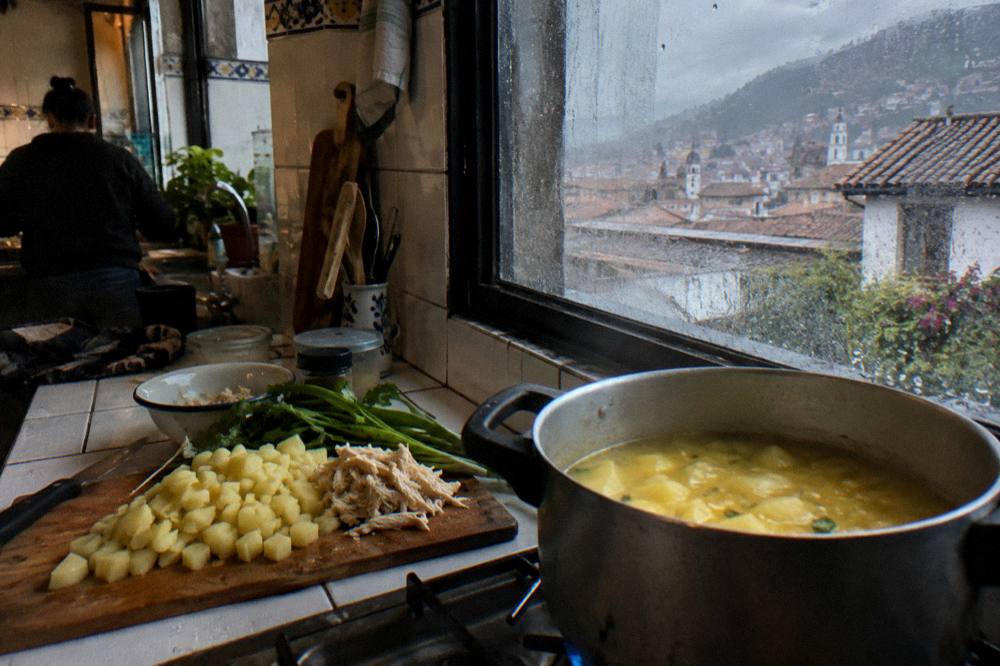
The common failure abroad is texture: cooks use one potato type and get either broth with chunks or uniform mush. The fix is treating the potatoes as three separate ingredients with three jobs, as in the table earlier in this guide. Chicken on the bone, poached and shredded, beats breast meat for the broth. Corn comes last, ten minutes or so, and the guascas goes in for the final stretch of simmering.
Sourcing in Bogotá is half the pleasure. Paloquemao market, open Monday to Saturday 4:30 a.m. to 4:30 p.m. and Sundays 5 a.m. to 4:30 p.m., sells all three potato varieties, dried guascas and pasture-raised chicken under one roof, and the early morning hours before about 10 a.m. carry the market's real energy, with vendors offering tastes of exotic fruit. Readers planning a cooking day can pair the shopping with the broader Paloquemao market food guide.

For everything else the city eats in a day, from changua breakfasts to late-night arepas, Bogota Food Tours keeps the full set of market, dish and tour guides in one place.
Common Questions About Ajiaco
What Is Ajiaco?
Ajiaco santafereño is Bogotá's signature soup: chicken broth thickened with three potato varieties, flavoured with the guascas herb, and served with corn on the cob plus table-side cream, capers, avocado and rice.
What Are The Three Potatoes In Ajiaco?
Papa criolla dissolves fully and thickens the broth, papa sabanera partially breaks down, and papa pastusa holds its shape. Together they give the soup body without cream or flour added at the stove.
Where Can I Eat Ajiaco In Bogotá?
Market plazas are the most reliable option: October 2026 reporting names five plazas for the dish, including 12 de Octubre in Barrios Unidos and the family-run stalls of La Perseverancia. Traditional restaurants across the centre and Chapinero also serve it daily.
How Much Does A Bowl Of Ajiaco Cost?
Reported delivery-menu prices run 23,700 COP for a medium 16 oz bowl and 33,900 COP for a large 24 oz bowl. Market-plaza bowls are generally the cheapest; check prices on site, since they move.
Do Bogotá Food Tours Include Ajiaco?
Some do, but only a walk's own stop list can say for a given day. The featured Viejo Bogota walk, rated 5.0 across 714 reviews, runs 4 hours from $55 per person; check its booking page for current stops before counting on ajiaco.
What Is Guascas?
Guascas is a dried herb, galinsoga, that gives ajiaco its distinctive grassy, faintly smoky flavour. It is sold by the bag in every Bogotá market plaza and is the ingredient hardest to substitute when cooking the soup abroad.