Usaquén Sunday Market And Food: What To Eat Around The Plaza
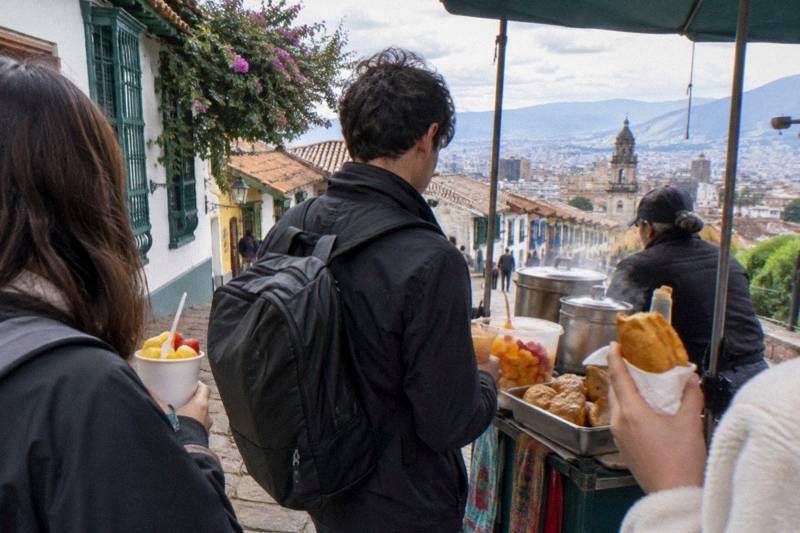
Usaquén runs its flea and food market on Saturdays, Sundays and holiday Mondays, and the neighbourhood around the plaza is one of the easiest Sunday food mornings in Bogotá. Here is what to eat, what it costs, and how to decide between a market wander and a guided tasting walk.
Short answer
The Usaquén market opens Saturdays, Sundays and holiday Mondays from 9:00 to 17:30 along Carrera 6A between Calles 119 and 120A. Food stalls sell arepas, empanadas, fresh-cut fruit and hot chocolate. No guided food walk in the range compared here runs to Usaquén, so most visitors wander the market on their own and pair it with a tasting walk in the historic centre.
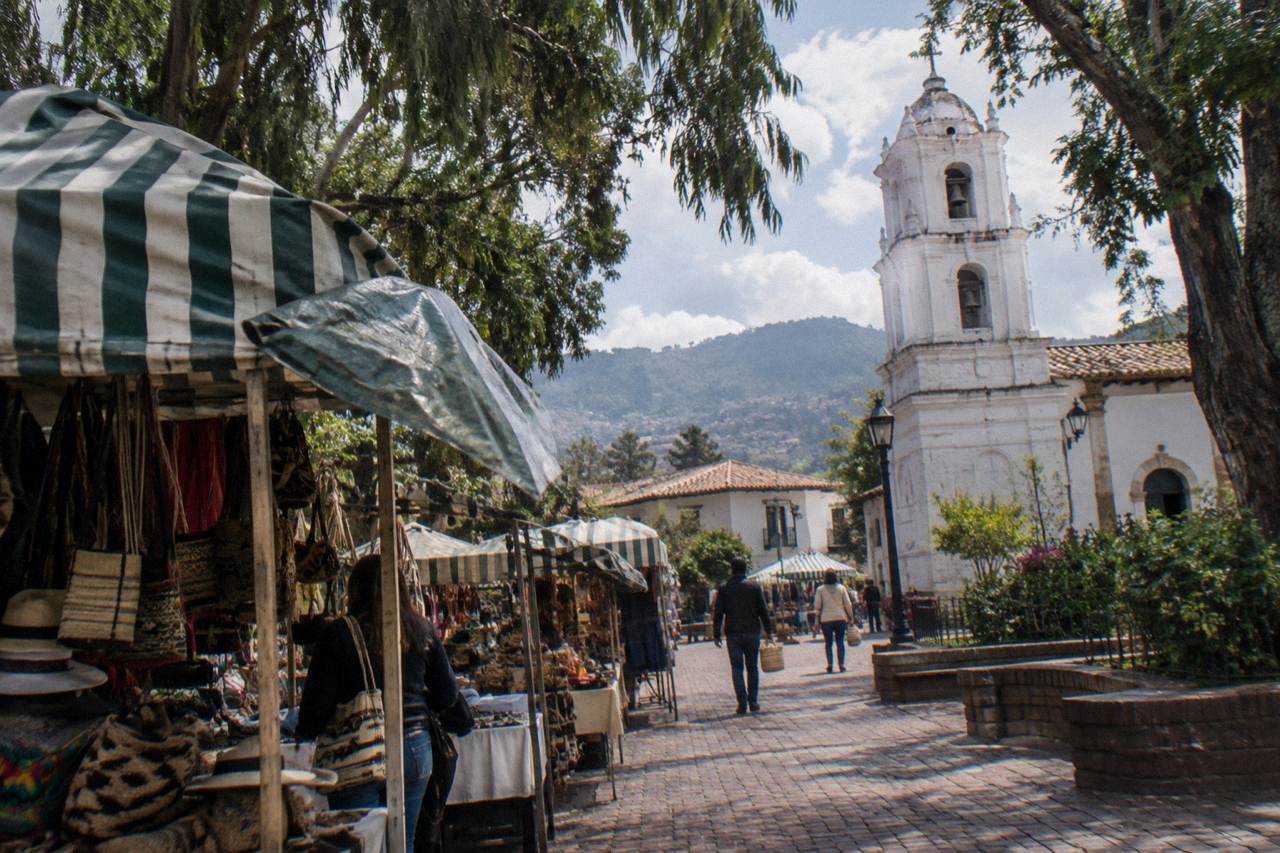
The Usaquén market is the calmest of Bogotá's weekend food rituals. While Paloquemao thumps with wholesale trade before dawn and La Candelaria hums with museum crowds, Usaquén, a former village that the city long ago absorbed into its northern edge and now one of its best dining neighbourhoods, spreads craft and food stalls along a leafy stretch of Carrera 6A one block from its plaza and church. On a Sunday the whole thing runs at a pace that suits a long breakfast, a slow circuit of the stalls, and lunch at one of the restaurants ringing the square.
This guide covers what the market is, what you can eat there and around the plaza, how to reach it from central Bogotá, and the honest question of whether to plan the day yourself or fold a guided food walk into the same trip. One thing worth saying early: none of the guided food walks compared on Bogota Food Tours runs to Usaquén itself. That is not a problem, it is a planning fact, and the best use of the neighbourhood is usually a self-guided market morning plus a booked tasting walk somewhere else in the city.
What Is The Usaquén Market And When Is It On?
The Mercado de las Pulgas de Usaquén is a flea and food market that operates Saturdays, Sundays and holiday Mondays from 9:00 in the morning to 5:30 in the evening, on Carrera 6A between Calles 119 and 120A, one block from Usaquén's main plaza and church. Entry is free, stalls are open air, and no ticket or booking is needed to browse or eat.
The market's own operator publishes those days and hours on its contact page, and they have held steady across recent reporting, which matters because plenty of visitors assume it is a Sunday-only event and miss the quieter Saturday version. Holiday Mondays are the sleeper: Colombians treat puente weekends as short trips, and a Monday market day can be thinner in stalls but far easier to walk.
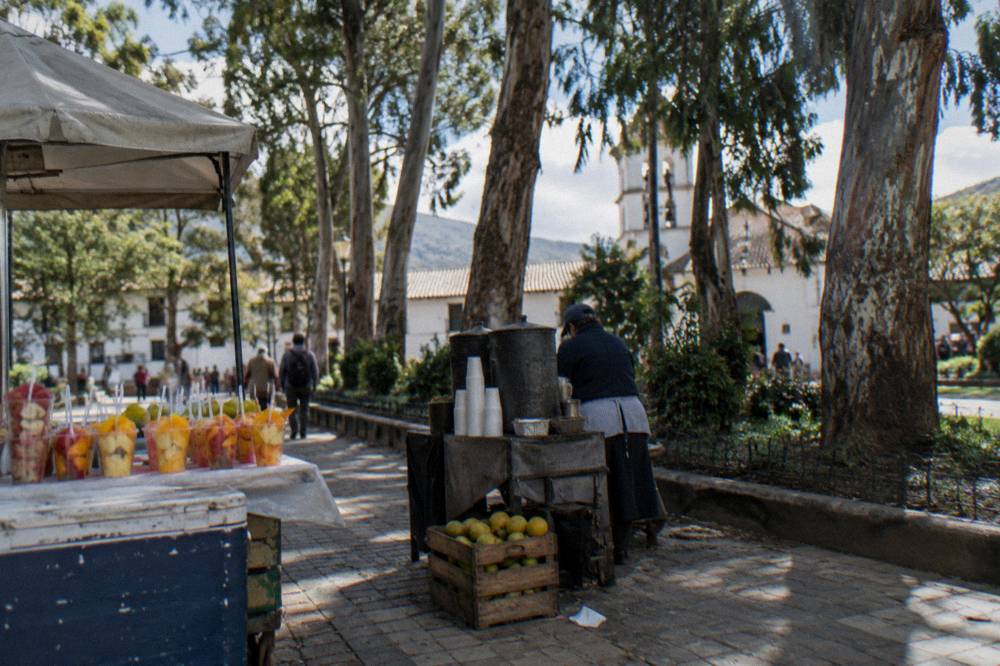
What you find is a hybrid. Half the stalls are a classic flea market, crafts, jewellery, second-hand goods, textiles, the kind of browsing that fills an hour. The other half is where this guide lives: food stalls selling arepas, fresh-cut fruit dressed with salt and lime, empanadas, and hot chocolate, reported consistently in recent visitor coverage of the market. The stalls sit in the open, steps from sit-down restaurants, so you can graze at a stall and still end the morning at a table.
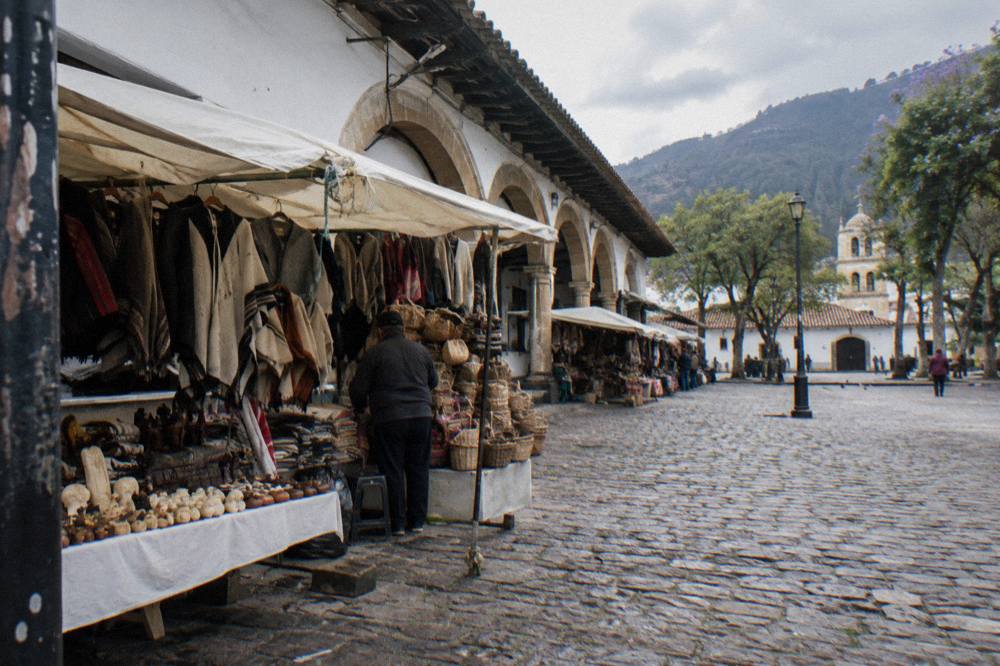
It helps to place Usaquén among the city's other market options before you commit a morning. Bogotá's district market plazas were mapped on an official 2026 route of seven plazas, each known for a specialty, and Usaquén sits at the small, touristic end of that spectrum while the big plazas carry the working-city energy. The comparison below uses only the hours and facts reported in the market cluster.
| Market | Reported days | Reported hours | Character |
|---|---|---|---|
| Usaquén flea and food market | Sat, Sun, holiday Mon | 9:00 to 17:30 | Open-air crafts, snacks, restaurant row |
| Paloquemao | Mon to Sat | 4:30 to 16:30 | Wholesale produce, exotic fruit, flowers until 11:00 |
| Paloquemao | Sun and holidays | 5:00 to 14:30 | Thinner, flower-focused morning |
| La Perseverancia | Mon to Fri | 8:00 to 16:00 | Traditional cooked food, family stalls |
| La Perseverancia | Sat and Sun | 6:00 to 17:00 | Ajiaco, lechona, fritanga on weekends |
| Samper Mendoza (nocturnal) | Mon and Thu | 21:00 to 5:00 | Herbs and plants, wholesale |
If your instinct is "one market is enough," the honest split is this: Usaquén for crafts plus grazing in a pretty setting, Paloquemao for fruit you have never seen, La Perseverancia for a full plate of Colombian cooking. The deep version of that second choice is in our Paloquemao market food guide, and the wider landscape is covered in Bogotá markets beyond Paloquemao.
What Can You Eat At The Usaquén Sunday Market?
The market's own food stalls concentrate on four things reported across recent coverage: arepas, empanadas, fresh-cut fruit served with salt and lime, and hot chocolate. Beyond the stalls, the plaza and surrounding streets are dense with restaurants serving crepes, grilled meats and traditional Colombian plates, so a full meal is always a block away.
Start with the stall foods because they are the cheapest and most local part of the morning. An arepa hot off the plancha, an empanada with aji, a cup of fruit cut in front of you: this is Colombian snacking at its most direct, and it maps neatly onto the broader street-food vocabulary of the city. If you want the full background on each of these, our arepas, empanadas and pan de bono guide explains what distinguishes them, and the Bogotá street food guide covers how Bogotá's street snacking works in general.
Hot chocolate deserves a special word because Usaquén's cool highland climate makes it a natural. Bogotá's traditional version, chocolate santafereño, comes with cheese to melt into the cup, and if the stall version leaves you curious, the full ritual, and where to try it with almojábanas in the historic centre, is in our hot chocolate with cheese guide.
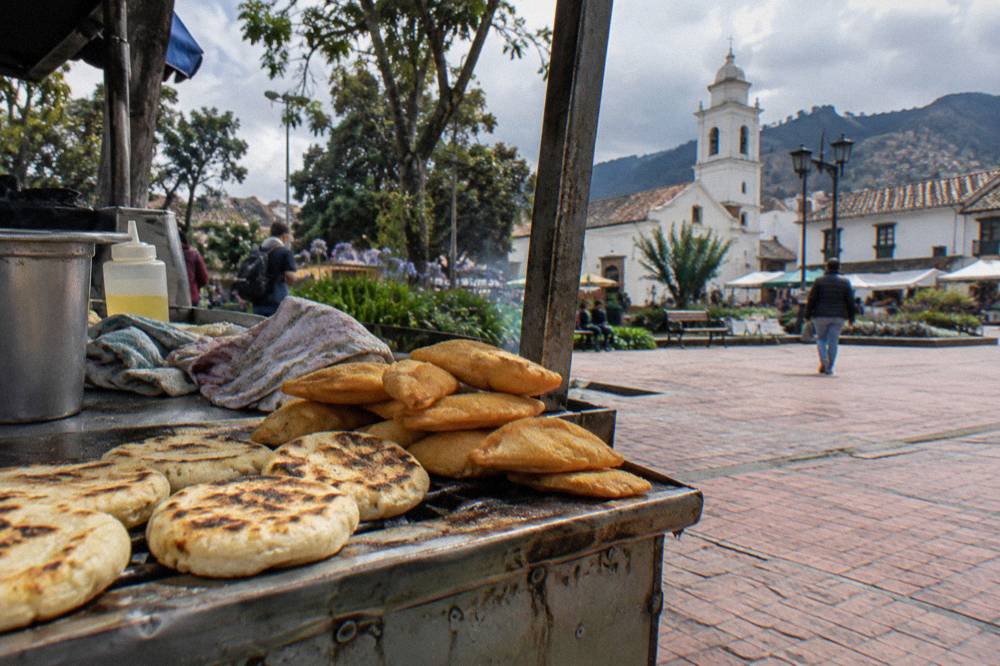
Stall names and prices are not published. The Sunday lineup follows the same pattern each week, so ask at the stalls on the day. Treat stall snacks as small cash purchases and carry Colombian pesos in small notes; market stalls rarely take cards. For scale, local reporting puts single bakery items elsewhere in the city at around 4,300 to 4,700 COP and a cup of lulo juice at a La Candelaria cart at 4,000 COP, which gives a rough sense of street-snack pricing, but check at the stall.
What the stalls do not cover, the neighbourhood does. Around the plaza you will find crepe restaurants that have made Usaquén a brunch destination, parrilla grills, and kitchens turning out traditional plates. Local reporting describes La Perseverancia's family stalls as the specialists in ajiaco, lechona and fritanga, and the same dishes appear on Usaquén menus in more polished form. If ajiaco is your target, the soup itself, and where to eat it, gets a full treatment in where to eat Bogotá's signature soup.
| Food | Where at Usaquén | What to expect | Pair it with |
|---|---|---|---|
| Arepas | Market stalls | Grilled corn cakes, cheese or butter on top | A hot chocolate |
| Empanadas | Market stalls | Fried, filled, served with aji sauce | Fresh fruit juice |
| Fresh-cut fruit | Market stalls | Cups of mango, pineapple and more, salt and lime | Nothing, it is its own course |
| Hot chocolate | Market stalls | Warm, thick, sometimes with cheese | An arepa or almojábana |
| Crepes | Plaza restaurants | Sweet and savoury, a Usaquén brunch staple | Coffee from a nearby roastery |
| Ajiaco and traditional plates | Plaza-adjacent restaurants | Chicken and potato soup, lechona, fritanga | A full sit-down lunch |
One planning note for dietary needs: none of the market stalls or neighbourhood restaurants is described in verified sources as vegan or gluten-free across the board, and about 36 percent of Bogotá restaurants offer some vegetarian or vegan options per a city report, so the honest advice is to ask at the stall or check menus. Our vegetarian, vegan and gluten-free guide covers the dedicated restaurants if that is your priority.
Restaurants Around The Plaza: Making Lunch The Main Event
The strongest food strategy in Usaquén is a two-part morning: graze the stalls for arepas, empanadas and fruit, then move to a plaza restaurant for a seated lunch of crepes, grilled meats or a traditional Colombian plate. The plaza's restaurant row is compact, walkable and busy by early afternoon, so arriving before 1 p.m. keeps the wait short.
The neighbourhood's dining scene benefits from Bogotá's northward drift of good restaurants. Time Out's 2026 ranking put Chapinero Alto, several kilometres south, among the world's coolest neighbourhoods, and Usaquén sits at the quieter, family-facing end of that same corridor, with a flea market in the middle of it on weekends. Practical reporting on the city consistently lists Usaquén among the more comfortable districts for visitors to walk, alongside Chapinero and Parque 93, with ordinary precautions.
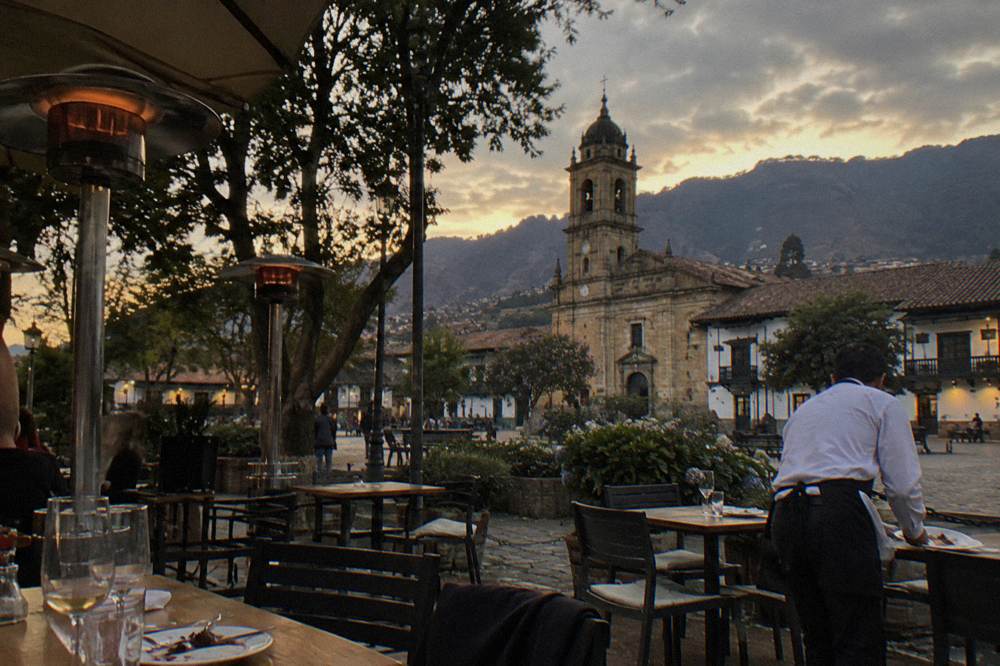
You will not find a Michelin-starred room here; the 2026 Michelin Guide coverage of Bogotá awarded Keys to three hotels in the city, not restaurant stars. What you get instead is dependable, pleasant eating within two blocks of the stalls: the crepe houses Usaquén is known for, coffee from a city that takes its roasteries seriously, and traditional plates done well. For coffee specifically, roasteries such as Colo Coffee Roasters in Usaquén itself, with visible in-house roasting and Colombian-only sourcing, and Catación Pública, which runs a certified cupping lab with public sessions, are both reported in the 2026 coffee cluster, and our best coffee shops in Bogotá guide maps the wider scene.
Lunch in Bogotá is the day's main meal, eaten late by northern habits, and prices at neighbourhood restaurants sit well below the city's festival-menu ceiling: the Bogotá Gourmet 2026 event priced fixed menus for two at 89,000 to 199,000 COP across more than 80 restaurants citywide, which gives a sense of the upper band rather than a Usaquén average. Everyday restaurant pricing in the neighbourhood is lower, but no verified Usaquén-specific restaurant prices exist in the sources, so check menus on site.
Should lunch in Usaquén feel like a decision you want made for you, the guided option runs elsewhere: the Viejo Bogota food walk with 12+ tastings is a 4-hour tasting route through the historic centre, rated 5.0 across 714 reviews, from $55 per person, the most reviewed food walk among the options compared here. It does not come to Usaquén, and that is the point of this whole guide: pick your neighbourhood, then decide whether that neighbourhood needs a guide.
How Do You Get To Usaquén From Central Bogotá?
Usaquén sits several kilometres north of La Candelaria, and the practical options are a taxi or ride app, which is a comfortable cross-city ride whose length depends on Sunday traffic, or public transport, where the TransMilenio fare is a flat COP 3,550 reported for 2026 with a 125-minute free transfer window. There is no metro-style station at the market itself, so the last stretch is on foot or a short feeder ride.
Sunday changes the calculus. Traffic is lighter than weekday peaks, which helps cars, but some trunk corridors run holiday schedules, which can slow buses. Reports from Bogotá confirm the unified fare of COP 3,550 effective from 14 January 2026 across TransMilenio, TransMiZonal and TransMiCable, with the transfer window intact, so a cross-city journey on public transport costs less than a coffee at a roastery. If you are staying in Chapinero or Zona G, Usaquén is close enough that a ride app is a small fare.
| Option | Approximate time | Reported cost | Notes |
|---|---|---|---|
| Taxi or ride app | A cross-city ride, traffic dependent | Metered, COP 3,550 for a bus ride is the comparison | Lightest option Sunday morning |
| TransMilenio plus walk | Roughly an hour door to door | COP 3,550 flat fare | 125-minute transfer window reported |
| Walking the whole way | Not practical, a long distance north | Free | Only for the ambitious |
For the return, note that the market closes at 17:30 and the stalls thin well before then. Late afternoon is when Usaquén's restaurant terraces fill instead. The full transport picture, including airport runs and the legal grey area around app-based cars, is in getting around Bogotá.
Market Wander Or A Guided Food Walk?
A Usaquén market morning is free, self-paced and best for grazing and crafts, while every guided food walk compared here runs in other neighbourhoods, chiefly La Candelaria and the historic centre, at prices from $17.71 to $55 per person for shared walks. The two are complements, not substitutes: most visitors do one of each on different days.
No tour among the options compared on this site runs to Usaquén, so the honest framing is this. If your day must include the flea market and a plaza lunch, plan it yourself using the hours and foods above. If your priority is tasting counted dishes with a guide explaining them, book a walk in the centre and give Usaquén a separate, slower morning.
The price spread among shared walks is wide and worth understanding. At the low end, the Shared Bogotá Street Food Tour runs 3 hours from $17.71 per person, rated 4.6 across 30 reviews, and the Shared Gastronomy Tour in the Historic Center is listed as a guide fee from $15 with tastings costing about US$12 extra, an important basis to read before comparing prices. In the middle, the Bogotá Food Experience: Cultural & Culinary Tour is a 4-hour walk from $47.15 per person, rated 4.9 across 615 reviews. At the upper end of the shared walks, the Viejo Bogota walk's $55 from-price buys its 12-plus tastings and the largest review pool of the group.
Between those two sit the walking formats that mix history with snacks. The Bogotá: True Colombian Walking Tour + Local Snacks runs 2 to 3 hours from $54.68 per person, rated 4.9 across 130 reviews, and the Food Tour in La Candelaria Bogotá covers 3 hours from $63 per person as a from-price that varies by group size, rated 4.9 across 72 reviews. Each listing states its own inclusions and meeting point, so check the booking page for the current stop list before choosing.
If Usaquén has already fixed your Sunday, the La Candelaria walk slots naturally into another day. The historic-centre version above pairs a colonial-district stroll with tastings, which is the closest thematic cousin to grazing a market with a local alongside you.

Planning Your Day: Hours, Weather And Budget
A comfortable Usaquén plan is a mid-morning arrival after 9:30, one circuit of the stalls, snack as you go, then a seated plaza lunch before 1 p.m., with the whole morning costing very little beyond lunch, since browsing is free and stall snacks are small cash purchases. Bogotá's rainy seasons run April to May and October to November, so a Sunday in those months can shift the plan indoors.
Altitude deserves one line: Bogotá sits at about 2,640 m, and the standard advice, echoed by city health guidance, is a day or two of taking it easy, plenty of water and lighter meals if you have just landed. A slow market morning is close to ideal for that. The full version is in eating at altitude in Bogotá.
Weather is the other variable. The 2026 outlook reports a strong El Niño pattern forecast above 90 percent probability for late 2026 into early 2027, expected to mean drier, sunnier days and colder nights than average through February 2027. For a market day that is mostly good news, but bring a layer, and check the forecast, since afternoon showers are never off the table in this city.
| Budget item | Planning range | Basis |
|---|---|---|
| Market browsing | Free | Open-air stalls, no entry fee |
| Stall snacks | Small cash purchases, bring COP notes | Prices set per stall, not published |
| Public transport each way | COP 3,550 reported | Flat 2026 fare, 125-minute transfers |
| Guided food walk, another day | From $17.71 to $55 per person for shared walks | From-prices as listed, one adds about US$12 in tastings |
| Plaza lunch | Check menus on site | No verified Usaquén restaurant prices in sources |
Two final practical notes. Tap water in Bogotá is officially potable, with the city's utility consistently in the low-risk band on water-quality indices, though some visitors still prefer bottled. And tipping: at sit-down restaurants staff will ask whether to add the voluntary 10 percent propina, capped by law; it is optional, and not expected at market stalls or counters. Details are in tipping in Bogotá.
For readers building a whole weekend, Usaquén slots best as the Sunday anchor, with a Paloquemao morning or a booked centre walk on Saturday: our Bogotá in 3 days food-first itinerary does exactly that sequencing.
Common Questions About The Usaquén Market
Is The Usaquén Market Only On Sundays?
No. The flea and food market operates Saturdays, Sundays and holiday Mondays, from 9:00 to 17:30 each of those days. Saturday tends to be quieter than Sunday, and holiday Mondays can have fewer stalls but far fewer visitors.
What Can You Eat At The Usaquén Market?
Reported stall foods are arepas, empanadas, fresh-cut fruit with salt and lime, and hot chocolate. Around the plaza, restaurants add crepes, grilled meats and traditional Colombian plates such as ajiaco to the options.
Do Any Guided Food Tours Go To Usaquén?
None of the guided walks compared on this site runs to Usaquén. The nearest equivalents are tasting walks in La Candelaria and the historic centre, which pair well with a separate self-guided Usaquén morning.
How Much Does The Usaquén Market Cost?
Browsing is free. Stall snacks are small cash purchases with no published prices, so carry Colombian pesos in small notes. Getting there by public transport costs a flat COP 3,550 reported for 2026.
How Do I Get To Usaquén From Central Bogotá?
The neighbourhood sits well north of La Candelaria. A taxi or ride app is the comfortable option on a Sunday; public transport uses the flat COP 3,550 fare with a 125-minute transfer window, plus a walk at the end.
What Are The Usaquén Market Hours?
9:00 in the morning to 5:30 in the evening on Saturdays, Sundays and holiday Mondays, on Carrera 6A between Calles 119 and 120A. Stalls thin out before the 17:30 close.